
TCS Industries Limited (China-sourced API supplier) supplies Sirolimus (Rapamycin) — API CAS 53123-88-9 for pharmaceutical B2B procurement — COA, MSDS, and technical documentation available on request.
> Overview
| Product Name | Sirolimus (Rapamycin) |
|---|---|
| Structural Formula | 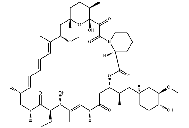 |
| CAS Number | 53123-88-9 |
| Molecular Formula | C51H79NO13 |
| Molecular Weight | 914.2 g/mol |
| InChIKey | QFJCIRLUMZQUOT-HPLJOQBZSA-N |
| SMILES | Available on request where applicable |
| Appearance | White to off-white powder |
| Purity / Grade | By agreed specification and batch COA |
| Storage | Store at 2–8°C, protect from light |
Sirolimus (CAS 53123-88-9, also known as rapamycin) is a macrolide immunosuppressant produced by Streptomyces hygroscopicus. It has the formula C₅₁H₇₉NO₁₃ (MW 914.17). Sirolimus inhibits mTOR (mechanistic target of rapamycin), blocking T-cell activation and proliferation. It is used for organ transplant rejection prophylaxis, lymphangioleiomyomatosis, and drug-eluting coronary stents.
TCS Industries Limited, a Hong Kong-based trading and sourcing company, supplies Sirolimus API in pharmaceutical grade for global procurement programs.
> Applications
Immunosuppressant for transplant rejection
Sirolimus binds FKBP12, and the sirolimus-FKBP12 complex inhibits mTOR Complex 1 (mTORC1), blocking IL-2-driven T-cell proliferation at the G1/S phase. Unlike calcineurin inhibitors (tacrolimus, cyclosporin), sirolimus is non-nephrotoxic. Oral dose is 1–5 mg/day with target trough levels of 4–20 ng/mL. Kahan et al. (N Engl J Med, 2000, 342:834–843) demonstrated that sirolimus-based regimens significantly reduced acute rejection rates in renal transplant recipients.
Drug-eluting stents and rare diseases
Sirolimus-coated coronary stents reduce in-stent restenosis by inhibiting vascular smooth muscle cell proliferation. Oral sirolimus (2 mg/day) is also FDA-approved for lymphangioleiomyomatosis (LAM). Research extends to oncology (mTOR-driven tumors) and anti-aging studies.
> Sourcing & Supply
TCS Industries Limited supports development, qualification and commercial purchasing discussions for Sirolimus (Rapamycin) with buyers in Australia, New Zealand, Canada and South Korea.
- Evaluation and commercial quantities: 50 g samples for analytical qualification; 500 g and 1 kg for formulation development; 5–25 kg for production. Fermentation-derived pharmaceutical-grade powder. DMF reference letters available.
- Pallet quantities and production campaigns: repeat supply is coordinated against packaging, lead time, annual demand and destination-market import requirements.
> Quality & Documentation
Key specification parameters include assay (≥96.0%), related substances (individual ≤0.5%, total ≤2.0%), water content, residual solvents, heavy metals, particle size distribution, and microbial limits. White to off-white powder. Practically insoluble in water, soluble in methanol, ethanol, and acetonitrile. Melting point 183–185 °C (decomposition). Identity by HPLC and IR. Meets USP and in-house pharmaceutical specifications. COA and MSDS are standard.
> Packaging
Sirolimus is a white to off-white powder, sensitive to light and heat. Standard packaging includes aluminium foil bags under nitrogen or vacuum in fibre drums (100 g, 500 g, 1 kg, or 5 kg). Store at -20 °C or 2–8 °C per manufacturer specification. Protect from light and moisture. Shelf life is typically 24 months under recommended conditions. Labels and documents are checked before dispatch.
> Pricing & MOQ
Pricing is quoted by specification, packaging and destination. Common commercial discussions use 25 kg bag/drum formats, pallet quantities and production-campaign planning; smaller samples may be reviewed for qualified formulation teams.
> Regulatory & Compounding Context
Sirolimus was FDA-approved in 1999 (Rapamune, Pfizer/Wyeth) for prevention of renal transplant rejection. EMA-authorized. FDA-approved for LAM (2015). On the WHO Model List of Essential Medicines. Generic sirolimus products available. Listed in the FDA IID for oral dosage forms. DMF support available from qualified manufacturers.
> Alias Index
- INN: Sirolimus
- CAS Number: 53123-88-9
- Formula: C₅₁H₇₉NO₁₃ (MW 914.17)
- Synonym: Rapamycin
- Brand name: Rapamune (Pfizer)
- ATC code: L04AD02
- Target: mTOR (mechanistic target of rapamycin)
- Commercial request terms: sirolimus API, rapamycin bulk, Rapamune generic, mTOR inhibitor API, TCS Industries Limited
> FAQ
How does Sirolimus differ from Tacrolimus?
Both bind FKBP12, but their complexes inhibit different targets. Sirolimus-FKBP12 inhibits mTOR (blocking T-cell proliferation). Tacrolimus-FKBP12 inhibits calcineurin (blocking IL-2 transcription). Sirolimus is non-nephrotoxic; tacrolimus is nephrotoxic. They are often used together at reduced doses to combine mechanisms while minimizing calcineurin inhibitor nephrotoxicity.
What documents are available for Sirolimus (Rapamycin) orders?
COA and MSDS are standard for commercial discussions. COO, packing list, invoice and other import-support documents can be arranged according to order scope.
Do you supply Sirolimus (Rapamycin) to Australia and Canada?
Yes. We support B2B buyers in Australia, New Zealand, Canada and South Korea, subject to route and document review.
Do you supply New Zealand and South Korea?
Yes. We review Australia, New Zealand, Canada and South Korea for project supply, import documents, packaging and logistics planning before quotation.
Why is cold storage required?
Sirolimus is a macrolide natural product susceptible to oxidative degradation and isomerization at elevated temperatures. Storage at -20 °C or 2–8 °C preserves chemical stability. At room temperature, degradation accelerates. The API and oral solution require cold chain logistics. Tablet formulations (Rapamune) include protective excipients for room-temperature stability.
Is Sirolimus produced by fermentation?
Yes. Sirolimus is produced by aerobic fermentation of Streptomyces hygroscopicus, followed by extraction, chromatographic purification, and crystallization. It is a secondary metabolite — production yield depends on fermentation conditions, media composition, and strain selection. Chemical total synthesis is possible but not commercially viable.
Can you arrange samples before commercial purchasing?
Samples or evaluation quantities may be reviewed for qualified buyers after target specification, application and destination-market requirements are clarified.
How is Sirolimus (Rapamycin) packaged for export?
Packaging is confirmed by quantity and material properties. Typical options include foil bags, HDPE containers, fibre drums, 25 kg bags or palletized export packaging.
Can buyer-defined specifications be reviewed?
Yes. Send the specification, methods, impurity limits and required documents. TCS can review feasibility before confirming quotation and lead time.
What payment terms are normally used?
Standard payment is 100% T/T before dispatch unless a different arrangement has been approved for an established commercial account.
What lead time should buyers expect?
Lead time depends on stock, batch size, document scope and destination. Available stock can move faster; made-to-order or pallet programs require longer planning.
What are the drug-eluting stent applications?
Sirolimus-coated coronary stents release the drug locally over 30–90 days, inhibiting smooth muscle proliferation and reducing in-stent restenosis from ~30% (bare metal) to <10%. The Cypher stent (Cordis) was the first sirolimus-eluting stent. Current devices use newer polymer coatings with controlled drug release kinetics.
Last reviewed: June 2026
Evaluation and research orders (≤10 kg) are shipped with COA, MSDS, and certificate of origin. Bulk commercial orders (>10 kg) qualify for volume pricing with a full technical documentation package available on request.
> Request a Quote
If your team already has a target application, estimated quantity, destination market, or documentation requirements, send those details so the commercial response can be prepared more efficiently.