
TCS Industries Limited supplies L-Liothyronine CAS 6893-02-3 for pharmaceutical B2B procurement — COA, MSDS, and technical documentation available on request.
> Overview
| Product Name | L-Liothyronine |
|---|---|
| Structural Formula | 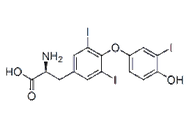 |
| CAS Number | 6893-02-3 |
| Molecular Formula | C15H12I3NO4 |
| Molecular Weight | 650.97 g/mol |
| InChIKey | AUYYCJSJGJYCDS-LBPRGKRZSA-N |
| SMILES | Available on request where applicable |
| Appearance | White to off-white crystalline powder |
| Purity / Grade | By agreed specification and batch COA |
| Storage | Store at controlled room temperature, protect from light and moisture |
L-Liothyronine (CAS 6893-02-3) is the free acid form of triiodothyronine (T3), the biologically active thyroid hormone. It has the formula C₁₅H₁₂I₃NO₄ (MW 650.97). L-Liothyronine is the pure L-enantiomer of T3, containing three iodine atoms per molecule. The free acid form is used as an intermediate in pharmaceutical manufacturing and in research applications.
TCS Industries Limited, a Hong Kong-based company, supplies L-Liothyronine (free acid) in pharmaceutical grade for global procurement programs.
> Applications
API intermediate and pharmaceutical manufacturing
L-Liothyronine free acid serves as the precursor for liothyronine sodium (the pharmaceutical salt form). It is converted to the sodium salt by controlled neutralization with sodium hydroxide. The free acid is also used for salt screening studies during formulation development. Burch et al. (Endocr Pract, 2019, 25:1066–1084) reviewed the pharmaceutical forms of triiodothyronine and their clinical applications in thyroid disease management.
Research and compounding
L-Liothyronine free acid is used in pharmaceutical research for binding studies, metabolic assays, and in-vitro cell culture experiments requiring T3. Compounding pharmacies may use the free acid as a starting material for custom T3 preparations (sustained-release capsules, sublingual formulations).
> Sourcing & Supply
TCS Industries Limited supports development, qualification and commercial purchasing discussions for L-Liothyronine with buyers in Australia, New Zealand, Canada and South Korea.
- Evaluation and commercial quantities: 10 g samples for analytical qualification; 100 g and 500 g for production. Pharmaceutical-grade free acid form. High-potency compound — microgram dosing applications.
- Pallet quantities and production campaigns: repeat supply is coordinated against packaging, lead time, annual demand and destination-market import requirements.
> Quality & Documentation
Key specification parameters include assay (≥95.0%), specific optical rotation (confirming L-configuration), related substances (diiodothyronine, thyroxine), loss on drying, heavy metals, and microbial limits. White to off-white powder. Practically insoluble in water, soluble in dilute NaOH and ethanol. Melting point 236–237 °C (decomposition). Identity by HPLC, IR, and optical rotation. Meets in-house pharmaceutical specifications. COA and MSDS are standard.
> Packaging
L-Liothyronine free acid is a white to off-white powder, light-sensitive. Standard packaging includes amber glass bottles or sealed foil bags (10 g, 50 g, or 100 g). Store at controlled room temperature (15–25 °C). Protect from light and moisture. Shelf life is typically 24 months. Labels and documents are checked before dispatch.
> Pricing & MOQ
Pricing is quoted by specification, packaging and destination. Common commercial discussions use 25 kg bag/drum formats, pallet quantities and production-campaign planning; smaller samples may be reviewed for qualified formulation teams.
> Regulatory & Compounding Context
L-Liothyronine free acid is an API intermediate. The sodium salt (liothyronine sodium) is the pharmacopoeial form (USP, Ph.Eur.). Free acid may be used for compounding and manufacturing under applicable pharmaceutical regulations. No separate monograph for the free acid in major pharmacopoeias. DMF support available for the sodium salt conversion.
> Alias Index
- Chemical name: O-(4-Hydroxy-3-iodophenyl)-3,5-diiodo-L-tyrosine
- CAS Number: 6893-02-3 (free acid); 55-06-1 (sodium salt)
- Formula: C₁₅H₁₂I₃NO₄ (MW 650.97)
- Abbreviation: L-T3, Triiodothyronine
- Related API: Liothyronine sodium (pharmaceutical salt form)
- Commercial request terms: L-liothyronine free acid, T3 free acid, triiodothyronine API, thyroid hormone intermediate, TCS Industries Limited
> FAQ
What is the difference between the free acid and sodium salt?
L-Liothyronine free acid (CAS 6893-02-3, MW 650.97) is the un-ionized form. Liothyronine sodium (CAS 55-06-1, MW 672.96) is the sodium salt form used in finished pharmaceutical products (Cytomel tablets). The sodium salt has better aqueous solubility and is the pharmacopoeial form for drug products.
What documents are available for L-Liothyronine orders?
COA and MSDS are standard for commercial discussions. COO, packing list, invoice and other import-support documents can be arranged according to order scope.
Do you supply L-Liothyronine to Australia and Canada?
Yes. We support B2B buyers in Australia, New Zealand, Canada and South Korea, subject to route and document review.
Do you supply New Zealand and South Korea?
Yes. We review Australia, New Zealand, Canada and South Korea for project supply, import documents, packaging and logistics planning before quotation.
Is the L-enantiomer important?
Yes. Only the L-enantiomer (natural configuration) has thyroid hormone biological activity. The D-enantiomer is essentially inactive at thyroid hormone receptors. Pharmaceutical-grade material must be enantiopure L-form, confirmed by specific optical rotation measurement. Chiral purity is a critical quality attribute.
Can the free acid be used directly in formulations?
The free acid has very low water solubility and is not suitable for direct use in most oral dosage forms. It must be converted to the sodium salt for pharmaceutical applications. However, some compounding pharmacies use the free acid in lipophilic or sustained-release formulations where water solubility is not required.
Can you arrange samples before commercial purchasing?
Samples or evaluation quantities may be reviewed for qualified buyers after target specification, application and destination-market requirements are clarified.
How is L-Liothyronine packaged for export?
Packaging is confirmed by quantity and material properties. Typical options include foil bags, HDPE containers, fibre drums, 25 kg bags or palletized export packaging.
Can buyer-defined specifications be reviewed?
Yes. Send the specification, methods, impurity limits and required documents. TCS can review feasibility before confirming quotation and lead time.
What payment terms are normally used?
Standard payment is 100% T/T before dispatch unless a different arrangement has been approved for an established commercial account.
What lead time should buyers expect?
Lead time depends on stock, batch size, document scope and destination. Available stock can move faster; made-to-order or pallet programs require longer planning.
What is the iodine content?
L-Liothyronine contains three iodine atoms per molecule, representing ~58.5% iodine by weight. Each 25 μg dose of liothyronine sodium provides ~14 μg of organic iodine. This is pharmacologically relevant because deiodination releases iodide that enters the systemic iodine pool.
Last reviewed: June 2026
Evaluation and research orders (≤10 kg) are shipped with COA, MSDS, and certificate of origin. Bulk commercial orders (>10 kg) qualify for volume pricing with a full technical documentation package available on request.
> Request a Quote
If your team already has a target application, estimated quantity, destination market, or documentation requirements, send those details so the commercial response can be prepared more efficiently.