
TCS Industries Limited (China-sourced API supplier) supplies Zonisamide — API CAS 68291-97-4 for pharmaceutical B2B procurement — COA, MSDS, and technical documentation available on request.
> Overview
| Product Name | Zonisamide |
|---|---|
| Structural Formula | 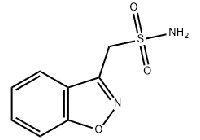 |
| CAS Number | 68291-97-4 |
| Molecular Formula | C₈H₈N₂O₃S |
| Molecular Weight | 212.23 g/mol |
| InChIKey | UBQNRHZMVUUOMG-UHFFFAOYSA-N |
| SMILES | Available on request where applicable |
| Appearance | White to off-white crystalline powder |
| Purity / Grade | By agreed specification and batch COA |
| Storage | Room temperature |
Zonisamide (CAS 68291-97-4) is a sulfonamide anticonvulsant with the formula C₈H₈N₂O₃S (MW 212.23). It has a benzisoxazole ring structure unrelated to other antiepileptic drugs. Zonisamide blocks voltage-gated sodium and T-type calcium channels, reduces glutamate release, and has weak carbonic anhydrase inhibitory activity. It is used for epilepsy and off-label for obesity and Parkinson disease.
TCS Industries Limited, a Hong Kong-based trading and sourcing company, supplies Zonisamide API in pharmaceutical grade for global procurement programs.
> Applications
Epilepsy — adjunctive and monotherapy
Zonisamide 100–600 mg once daily is used for partial seizures (focal onset) as adjunctive therapy and as monotherapy in some markets. Its multiple mechanisms (sodium channel blockade, T-type calcium channel blockade, glutamate release reduction) provide broad-spectrum antiseizure activity. Murata et al. (Epilepsy Res, 2007, 74:171–174) reported the long-term efficacy and safety of zonisamide in Japanese patients with partial and generalized epilepsy across a 12-year follow-up period.
Weight loss and Parkinson disease
Zonisamide causes weight loss (~5% body weight) as a frequent side effect, leading to investigation in obesity. It is approved in Japan for adjunctive Parkinson disease treatment (25–50 mg/day), where it may modulate dopaminergic and MAO-B activity.
> Sourcing & Supply
TCS Industries Limited supports development, qualification and commercial purchasing discussions for Zonisamide with buyers in Australia, New Zealand, Canada and South Korea.
- Evaluation and commercial quantities: 500 g samples for formulation development; 5 kg and 25 kg for production. Pharmaceutical (USP/JP) grade crystalline powder. DMF reference letters available.
- Pallet quantities and production campaigns: repeat supply is coordinated against packaging, lead time, annual demand and destination-market import requirements.
> Quality & Documentation
Key specification parameters include assay (≥99.0%), related substances, loss on drying, residue on ignition, heavy metals, residual solvents, and microbial limits. White to off-white crystalline powder. Slightly soluble in water, soluble in methanol and DMSO. Melting point 161–163 °C. Identity by HPLC, IR, and melting point. Meets USP (Zonisamide) and JP. COA and MSDS are standard.
> Packaging
Zonisamide is a white to off-white crystalline powder. Standard packaging includes double PE-lined foil bags in fibre drums (1 kg, 5 kg, or 25 kg). Store at controlled room temperature (15–25 °C). Protect from light and moisture. Shelf life is typically 36 months. Labels and documents are checked before dispatch.
> Pricing & MOQ
Pricing is quoted by specification, packaging and destination. Common commercial discussions use 25 kg bag/drum formats, pallet quantities and production-campaign planning; smaller samples may be reviewed for qualified formulation teams.
> Regulatory & Compounding Context
Zonisamide is monographed in USP and JP. FDA-approved in 2000 (Zonegran) as adjunctive therapy for partial seizures. Initially developed and marketed in Japan (1989) by Dainippon. EMA-authorized. Off-patent with multiple generic approvals. Approved for Parkinson disease in Japan. DMF support available.
> Alias Index
- INN: Zonisamide
- CAS Number: 68291-97-4
- Formula: C₈H₈N₂O₃S (MW 212.23)
- Brand name: Zonegran (Eisai)
- ATC code: N03AX15
- Pharmacological class: Benzisoxazole sulfonamide anticonvulsant
- Commercial request terms: zonisamide API, Zonegran generic, anticonvulsant API, benzisoxazole anticonvulsant, TCS Industries Limited
> FAQ
What are the main side effects?
Common side effects include somnolence, dizziness, anorexia/weight loss, cognitive impairment (word-finding difficulty), and kidney stones (1–2%, due to carbonic anhydrase inhibition). Rare but serious: oligohydrosis (decreased sweating) in children, metabolic acidosis, and sulfonamide hypersensitivity. Monitor bicarbonate levels and renal function.
What documents are available for Zonisamide orders?
COA and MSDS are standard for commercial discussions. COO, packing list, invoice and other import-support documents can be arranged according to order scope.
Do you supply Zonisamide to Australia and Canada?
Yes. We support B2B buyers in Australia, New Zealand, Canada and South Korea, subject to route and document review.
Do you supply New Zealand and South Korea?
Yes. We review Australia, New Zealand, Canada and South Korea for project supply, import documents, packaging and logistics planning before quotation.
How does Zonisamide cause weight loss?
The mechanism is not fully established. It likely involves appetite suppression through serotonergic modulation, dopamine/norepinephrine effects, and possibly carbonic anhydrase-mediated metabolic acidosis. Average weight loss is ~5% over 6–12 months. This effect has been studied in obesity trials and is the basis for off-label weight management use.
Is Zonisamide a sulfonamide?
Yes. Zonisamide contains a sulfonamide group. Patients with documented sulfonamide allergy should use it with caution. However, the cross-reactivity risk between sulfonamide antibiotics and non-antibiotic sulfonamides is debated. Clinical judgment and allergy history details (reaction type, severity) should guide prescribing decisions.
Can you arrange samples before commercial purchasing?
Samples or evaluation quantities may be reviewed for qualified buyers after target specification, application and destination-market requirements are clarified.
How is Zonisamide packaged for export?
Packaging is confirmed by quantity and material properties. Typical options include foil bags, HDPE containers, fibre drums, 25 kg bags or palletized export packaging.
Can buyer-defined specifications be reviewed?
Yes. Send the specification, methods, impurity limits and required documents. TCS can review feasibility before confirming quotation and lead time.
What payment terms are normally used?
Standard payment is 100% T/T before dispatch unless a different arrangement has been approved for an established commercial account.
What lead time should buyers expect?
Lead time depends on stock, batch size, document scope and destination. Available stock can move faster; made-to-order or pallet programs require longer planning.
Is a DMF available?
Yes. TCS sources zonisamide from manufacturers who maintain active DMFs with the FDA and equivalent regulatory submissions. Off-patent with generic competition. COA, stability data, and DMF reference letters provided.
Last reviewed: June 2026
Evaluation and research orders (≤10 kg) are shipped with COA, MSDS, and certificate of origin. Bulk commercial orders (>10 kg) qualify for volume pricing with a full technical documentation package available on request.
> Request a Quote
If your team already has a target application, estimated quantity, destination market, or documentation requirements, send those details so the commercial response can be prepared more efficiently.