
TCS Industries Limited (China-sourced API supplier) supplies Fenofibrate — API CAS 49562-28-9 for pharmaceutical B2B procurement — COA, MSDS, and technical documentation available on request.
> Overview
| Product Name | Fenofibrate |
|---|---|
| Structural Formula | 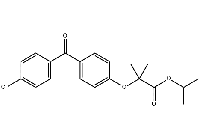 |
| CAS Number | 49562-28-9 |
| Molecular Formula | C₂₀H₂₁ClO₄ |
| Molecular Weight | 360.8 g/mol |
| InChIKey | YMTINGFKWWXKFG-UHFFFAOYSA-N |
| SMILES | Available on request where applicable |
| Appearance | White crystalline powder |
| Purity / Grade | By agreed specification and batch COA |
| Storage | Room temperature, protect from moisture |
Fenofibrate (CAS 49562-28-9) is a fibric acid derivative (fibrate) with the formula C₂₀H₂₁ClO₄ (MW 360.83). It is a prodrug hydrolyzed to fenofibric acid, which activates peroxisome proliferator-activated receptor alpha (PPARα). This reduces triglycerides by 30–50%, raises HDL by 10–20%, and modestly lowers LDL. Fenofibrate is used for hypertriglyceridemia and mixed dyslipidemia.
TCS Industries Limited, a Hong Kong-based trading and sourcing company, supplies Fenofibrate API in pharmaceutical grade for global procurement programs.
> Applications
Hypertriglyceridemia and mixed dyslipidemia
Fenofibrate 145–160 mg (micronized) or 48–145 mg (nanoparticle) once daily reduces triglycerides by enhancing lipoprotein lipase-mediated triglyceride hydrolysis, reducing hepatic VLDL production, and increasing VLDL clearance. It also raises HDL by increasing apolipoprotein A-I and A-II synthesis. Keating et al. (Drugs, 2007, 67:121–153) reviewed the pharmacological profile and clinical efficacy of fenofibrate across formulations and indications including its role in diabetic dyslipidemia management.
Diabetic microvascular protection
The FIELD and ACCORD-Lipid trials showed fenofibrate reduces diabetic retinopathy progression and albuminuria in type 2 diabetes, independent of lipid effects. The mechanism may involve PPARα-mediated anti-inflammatory and anti-angiogenic actions in retinal microvasculature.
> Sourcing & Supply
TCS Industries Limited supports development, qualification and commercial purchasing discussions for Fenofibrate with buyers in Australia, New Zealand, Canada and South Korea.
- Evaluation and commercial quantities: 1 kg samples for formulation development; 5 kg and 25 kg for production. Pharmaceutical (USP/Ph.Eur.) grade. Standard and micronized particle size grades available. DMF reference letters provided.
- Pallet quantities and production campaigns: repeat supply is coordinated against packaging, lead time, annual demand and destination-market import requirements.
> Quality & Documentation
Key specification parameters include assay (≥99.0%), related substances (4-chlorophenol, individual ≤0.1%, total ≤0.3%), loss on drying, residue on ignition, heavy metals, residual solvents, particle size (micronized grade), and microbial limits. White crystalline powder. Practically insoluble in water, soluble in acetone and dichloromethane. Melting point 79–82 °C. Identity by HPLC, IR, and melting point. Meets USP (Fenofibrate), Ph.Eur. (Fenofibratum), and BP. COA and MSDS are standard.
> Packaging
Fenofibrate is a white crystalline powder. Standard packaging includes double PE-lined foil bags in fibre drums (1 kg, 5 kg, or 25 kg). Store at controlled room temperature (15–25 °C). Protect from moisture. Low melting point (79–82 °C) — avoid heat exposure. Shelf life is typically 36 months. Labels and documents are checked before dispatch.
> Pricing & MOQ
Pricing is quoted by specification, packaging and destination. Common commercial discussions use 25 kg bag/drum formats, pallet quantities and production-campaign planning; smaller samples may be reviewed for qualified formulation teams.
> Regulatory & Compounding Context
Fenofibrate is monographed in USP, Ph.Eur. (Fenofibratum), and BP. FDA-approved in 1993 (Tricor). Multiple formulations: standard, micronized (Lofibra), nanocrystal (Triglide), and choline salt (Trilipix/fenofibric acid). EMA-authorized. Off-patent with extensive generic availability. DMF support available.
> Alias Index
- INN: Fenofibrate
- CAS Number: 49562-28-9
- Formula: C₂₀H₂₁ClO₄ (MW 360.83)
- Brand names: Tricor, Lofibra, Triglide, Lipanthyl
- ATC code: C10AB05
- Active metabolite: Fenofibric acid
- Commercial request terms: fenofibrate API, Tricor generic, fibrate API, PPARα agonist, triglyceride-lowering API, TCS Industries Limited
> FAQ
Can Fenofibrate be combined with statins?
Yes. Fenofibrate is the preferred fibrate for statin combination therapy. Unlike gemfibrozil (which inhibits statin glucuronidation and increases rhabdomyolysis risk), fenofibrate does not significantly interact with statin metabolism. The ACCORD-Lipid trial used fenofibrate + simvastatin in diabetic patients. Gemfibrozil-statin combinations are contraindicated.
What documents are available for Fenofibrate orders?
COA and MSDS are standard for commercial discussions. COO, packing list, invoice and other import-support documents can be arranged according to order scope.
Do you supply Fenofibrate to Australia and Canada?
Yes. We support B2B buyers in Australia, New Zealand, Canada and South Korea, subject to route and document review.
Do you supply New Zealand and South Korea?
Yes. We review Australia, New Zealand, Canada and South Korea for project supply, import documents, packaging and logistics planning before quotation.
Why are there so many Fenofibrate formulations?
Fenofibrate has low aqueous solubility and variable bioavailability. Different formulations address this: standard (require food for absorption), micronized (improved absorption with food), nanocrystal/Triglide (food-independent absorption), and fenofibric acid/Trilipix (active metabolite, food-independent). Each represents a formulation improvement, and each has separate generic competition.
How does Fenofibrate protect against diabetic retinopathy?
The FIELD trial showed 30% reduction in laser treatment for diabetic retinopathy with fenofibrate. The mechanism is not fully established but may involve PPARα activation reducing retinal inflammation, VEGF expression, and lipid-mediated endothelial dysfunction. This effect is independent of triglyceride lowering and may involve direct retinal PPARα activation.
Can you arrange samples before commercial purchasing?
Samples or evaluation quantities may be reviewed for qualified buyers after target specification, application and destination-market requirements are clarified.
How is Fenofibrate packaged for export?
Packaging is confirmed by quantity and material properties. Typical options include foil bags, HDPE containers, fibre drums, 25 kg bags or palletized export packaging.
Can buyer-defined specifications be reviewed?
Yes. Send the specification, methods, impurity limits and required documents. TCS can review feasibility before confirming quotation and lead time.
What payment terms are normally used?
Standard payment is 100% T/T before dispatch unless a different arrangement has been approved for an established commercial account.
What lead time should buyers expect?
Lead time depends on stock, batch size, document scope and destination. Available stock can move faster; made-to-order or pallet programs require longer planning.
Is a DMF available?
Yes. TCS sources fenofibrate from manufacturers who maintain active DMFs with the FDA and ASMF/CEP with EMA. Standard and micronized grades for different formulation technologies. Off-patent with extensive generic competition. COA, stability data, and DMF reference letters provided.
Last reviewed: June 2026
Evaluation and research orders (≤10 kg) are shipped with COA, MSDS, and certificate of origin. Bulk commercial orders (>10 kg) qualify for volume pricing with a full technical documentation package available on request.
> Request a Quote
If your team already has a target application, estimated quantity, destination market, or documentation requirements, send those details so the commercial response can be prepared more efficiently.