
TCS Industries Limited (China-sourced API supplier) supplies Coenzyme Q10 — API CAS 303-98-0 for pharmaceutical B2B procurement — COA, MSDS, and technical documentation available on request.
> Overview
| Product Name | Coenzyme Q10 |
|---|---|
| Structural Formula | 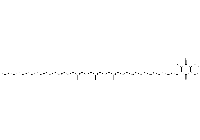 |
| CAS Number | 303-98-0 |
| Molecular Formula | C₅₉H₉₀O₄ |
| Molecular Weight | 863.3 g/mol |
| InChIKey | ACTIUHUUMQJHFO-UPTCCGCDSA-N |
| SMILES | Available on request where applicable |
| Appearance | Yellow to orange crystalline powder |
| Purity / Grade | By agreed specification and batch COA |
| Storage | Room temperature, protect from light, sealed container |
Coenzyme Q10 (CAS 303-98-0) is a naturally occurring benzoquinone with the formula C₅₉H₉₀O₄ (MW 863.34), also known as ubiquinone-10 or CoQ10. It is a lipid-soluble antioxidant found in mitochondrial membranes, essential for the electron transport chain in cellular energy production. Coenzyme Q10 is used in pharmaceutical products for heart failure adjunctive therapy and as a widely used nutraceutical supplement for cardiovascular and energy support.
TCS Industries Limited, a Hong Kong-based trading and sourcing company, supplies Coenzyme Q10 in pharmaceutical and nutraceutical grades produced by yeast fermentation.
> Applications
Cardiovascular health and heart failure adjunctive therapy
Coenzyme Q10 is used as adjunctive therapy in chronic heart failure and statin-associated myopathy. Clinical supplementation doses range from 100–300 mg/day for cardiovascular indications. The Q-SYMBIO randomized controlled trial showed CoQ10 supplementation reduced major adverse cardiovascular events in HF patients. Mortensen et al. (JACC Heart Fail, 2014, 2:641–649) reported the primary outcomes demonstrating significant reduction in cardiovascular mortality with CoQ10 supplementation.
Nutraceutical supplement and cosmetic ingredient
CoQ10 is one of the top-selling dietary supplement ingredients globally, marketed for energy, anti-aging, and antioxidant protection. It is formulated in softgel capsules, tablets, and liquid formulations. In cosmetics, CoQ10 (ubiquinone or ubiquinol) is used in anti-aging serums and creams at 0.01–0.5% concentration. Both oxidized (ubiquinone) and reduced (ubiquinol) forms are commercially available.
> Sourcing & Supply
TCS Industries Limited supports development, qualification and commercial purchasing discussions for Coenzyme Q10 with buyers in Australia, New Zealand, Canada and South Korea.
- Evaluation and commercial quantities: 1 kg samples for qualification; 5 kg to 25 kg for production. Fermentation-derived, all-trans CoQ10 in pharma and nutraceutical grades. Ubiquinone and ubiquinol forms available.
- Pallet quantities and production campaigns: repeat supply is coordinated against packaging, lead time, annual demand and destination-market import requirements.
> Quality & Documentation
Key specification parameters include assay (≥98.0% CoQ10 by HPLC for pharma grade), related substances (total ≤2.0%), residual solvents, heavy metals (Pb, As, Cd, Hg), microbial limits, water content, and particle size distribution. The orange crystalline powder has characteristic UV absorption at 275 nm. Melting point 48–52 °C. Fermentation-derived CoQ10 is the all-trans isomer; synthetic material may contain cis-isomer impurities. COA and MSDS are standard.
> Packaging
Coenzyme Q10 is sensitive to light and has a low melting point (48–52 °C). Standard packaging includes aluminum foil bags (vacuum-sealed or nitrogen-flushed) in fibre drums. Store at controlled room temperature (15–25 °C) protected from light and heat. Avoid temperatures above 40 °C during transport. Shelf life is typically 24 months. Labels and documents are checked before dispatch.
> Pricing & MOQ
Pricing is quoted by specification, packaging and destination. Common commercial discussions use 25 kg bag/drum formats, pallet quantities and production-campaign planning; smaller samples may be reviewed for qualified formulation teams.
> Regulatory & Compounding Context
Coenzyme Q10 (ubiquinone) is widely permitted as a food supplement ingredient globally. GRAS in the US. In the EU, it is on the market as a food supplement but is not harmonized at EU level — member state regulations apply. Monographed in USP-NF (Ubidecarenone). Listed in the FDA IID. Ph.Eur. includes a monograph for Ubidecarenone. Not classified as dangerous goods for transport.
> Alias Index
- IUPAC: Ubiquinone-10
- CAS Number: 303-98-0
- Formula: C₅₉H₉₀O₄ (MW 863.34)
- Pharmacopoeial name: Ubidecarenone (USP, Ph.Eur.)
- Common names: CoQ10, Ubiquinone, Coenzyme Q, Ubidecarenone
- Reduced form: Ubiquinol (CAS 992-78-9)
- InChIKey: ACTIUHUUMQJHFO-UHFFFAOYSA-N
- Commercial request terms: coenzyme Q10 pharma grade, CoQ10 ubiquinone, ubidecarenone USP, fermentation CoQ10, TCS Industries Limited
> FAQ
What is the difference between Ubiquinone and Ubiquinol?
Ubiquinone (CoQ10, CAS 303-98-0) is the oxidized form. Ubiquinol (CAS 992-78-9) is the reduced, electron-rich form. Both are interconverted in the body. Ubiquinol has better oral absorption but lower stability than ubiquinone. They are different products with different CAS numbers and handling requirements.
What documents are available for Coenzyme Q10 orders?
COA and MSDS are standard for commercial discussions. COO, packing list, invoice and other import-support documents can be arranged according to order scope.
Do you supply Coenzyme Q10 to Australia and Canada?
Yes. We support B2B buyers in Australia, New Zealand, Canada and South Korea, subject to route and document review.
Do you supply New Zealand and South Korea?
Yes. We review Australia, New Zealand, Canada and South Korea for project supply, import documents, packaging and logistics planning before quotation.
Is CoQ10 produced by fermentation or chemical synthesis?
Commercial CoQ10 is produced primarily by yeast fermentation (Rhodosprillum rubrum or engineered Agrobacterium strains), which yields the natural all-trans isomer. Chemical synthesis produces a mixture of cis- and trans-isomers. Fermentation-derived material is preferred. TCS sources fermentation-derived CoQ10.
What pharmaceutical indication does CoQ10 have?
CoQ10 (ubidecarenone) is used as adjunctive therapy in chronic heart failure. It is monographed in USP-NF and Ph.Eur. Clinical doses for cardiovascular indications are 100–300 mg/day. It is also used for management of statin-associated myopathy symptoms.
Can you arrange samples before commercial purchasing?
Samples or evaluation quantities may be reviewed for qualified buyers after target specification, application and destination-market requirements are clarified.
How is Coenzyme Q10 packaged for export?
Packaging is confirmed by quantity and material properties. Typical options include foil bags, HDPE containers, fibre drums, 25 kg bags or palletized export packaging.
Can buyer-defined specifications be reviewed?
Yes. Send the specification, methods, impurity limits and required documents. TCS can review feasibility before confirming quotation and lead time.
What payment terms are normally used?
Standard payment is 100% T/T before dispatch unless a different arrangement has been approved for an established commercial account.
What lead time should buyers expect?
Lead time depends on stock, batch size, document scope and destination. Available stock can move faster; made-to-order or pallet programs require longer planning.
Why must CoQ10 be protected from heat?
CoQ10 has a low melting point (48–52 °C) and will form a waxy mass if exposed to temperatures above 40 °C during transport or storage. Once melted and resolidified, particle size distribution and dissolution characteristics change. Temperature-controlled transport is recommended for summer shipments.
Last reviewed: June 2026
Evaluation and research orders (≤10 kg) are shipped with COA, MSDS, and certificate of origin. Bulk commercial orders (>10 kg) qualify for volume pricing with a full technical documentation package available on request.
> Request a Quote
If your team already has a target application, estimated quantity, destination market, or documentation requirements, send those details so the commercial response can be prepared more efficiently.