
TCS Industries Limited (China-sourced API supplier) supplies Rutin — Plant Extract CAS 153-18-4 for pharmaceutical B2B procurement — COA, MSDS, and technical documentation available on request.
> Overview
| Product Name | Rutin |
|---|---|
| Structural Formula | 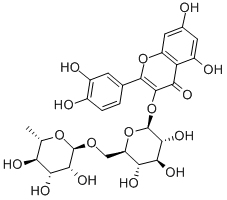 |
| CAS Number | 153-18-4 |
| Molecular Formula | C27H30O16 |
| Molecular Weight | 610.5 g/mol |
| InChIKey | IKGXIBQEEMLURG-NVPNHPEKSA-N |
| SMILES | Available on request where applicable |
| Appearance | Yellow to yellow-green crystalline powder |
| Purity / Grade | By agreed specification and batch COA |
| Storage | Keep tightly closed in a cool, dry, well-ventilated place |
Rutin (CAS 153-18-4) is a flavonoid glycoside with the formula C₂₇H₃₀O₁₆ (MW 610.52), consisting of quercetin bound to the disaccharide rutinose (rhamnose-glucose). It is named after Ruta graveolens (common rue) and is abundant in buckwheat, asparagus, citrus fruits, and Sophora japonica (Japanese pagoda tree) flower buds — the primary commercial extraction source. Rutin is used in pharmaceutical preparations for capillary fragility and as a nutraceutical antioxidant.
TCS Industries Limited, a Hong Kong-based trading and sourcing company, supplies Rutin in pharmaceutical and nutraceutical grades for global procurement programs.
> Applications
Capillary-protective and venotonic pharmaceutical use
Rutin and its semi-synthetic derivative troxerutin are used in oral preparations for treatment of chronic venous insufficiency, hemorrhoids, and capillary fragility. The pharmacological action involves strengthening capillary walls and reducing permeability. Rutin is typically formulated at 500 mg per tablet. Scalbert et al. (Am J Clin Nutr, 2005, 81:215S–217S) reviewed the bioavailability and bioefficacy of polyphenols including rutin in clinical nutrition contexts.
Nutraceutical antioxidant and natural product research
Rutin is used in dietary supplement formulations as a bioflavonoid antioxidant, often combined with vitamin C (historically marketed as “vitamin P” in older literature). In natural product chemistry, rutin is a reference standard for HPLC analysis of flavonoid glycosides. The hydrate form (rutin trihydrate) is the standard commercial material. Buckwheat-derived rutin is used in functional food applications in Asian markets.
> Sourcing & Supply
TCS Industries Limited supports development, qualification and commercial purchasing discussions for Rutin with buyers in Germany, France, Italy, Spain, the United Kingdom, the United States, Canada and Australia.
- Evaluation samples: botanical identity, assay basis and document needs are reviewed before dispatch.
- Commercial lots: repeat supply is arranged by specification, extract ratio, marker compound and destination-market requirements.
> Quality & Documentation
Key specification parameters include assay (≥95.0% rutin by HPLC for pharma grade), water content (trihydrate form contains ~8.8% water), related substances (quercetin, isoquercitrin), heavy metals (Pb, As, Cd, Hg), residual solvents, ash, and microbial limits. Identity confirmed by HPLC, UV absorption (λmax ~257 nm, ~359 nm), and characteristic yellow-green crystalline powder. COA and MSDS are standard.
> Packaging
Rutin is a yellow-green crystalline powder, stable under normal storage conditions. Standard packaging includes 25 kg fibre drums with PE liner or cartons with inner aluminum foil bags. Store at controlled room temperature (15–25 °C) protected from light and moisture. Shelf life is typically 36 months. Labels and documents are checked before dispatch.
> Pricing & MOQ
Pricing is quoted by marker specification, extract ratio, packaging and destination. Samples, 25 kg packs and pallet quantities can be discussed according to project stage.
> Regulatory & Compounding Context
Rutin is monographed in multiple pharmacopoeias including Ph.Eur. (Rutosidum trihydricum), ChP, and JP. Listed in the FDA IID. Used as a dietary supplement ingredient globally. Approved for pharmaceutical use in many EU member states for capillary disorders. Not classified as dangerous goods. Buyers should specify grade (pharmaceutical, nutraceutical) and pharmacopoeial reference at inquiry.
> Alias Index
- IUPAC: Quercetin-3-O-rutinoside
- CAS Number: 153-18-4
- Formula: C₂₇H₃₀O₁₆ (MW 610.52)
- Pharmacopoeial name: Rutosidum trihydricum (Ph.Eur.)
- Common names: Rutoside, Vitamin P (historical), Sophorin
- Aglycone: Quercetin (CAS 117-39-5)
- Natural source: Sophora japonica flower buds, buckwheat, citrus peel
- InChIKey: IKGXIBQKUUQPJM-UHFFFAOYSA-N
- Commercial request terms: rutin NF, rutoside pharma grade, bioflavonoid, quercetin rutinoside, Sophora japonica extract, TCS Industries Limited
> FAQ
What is the source of Rutin supplied by TCS?
Commercial rutin is primarily extracted from Sophora japonica (Japanese pagoda tree) flower buds, which contain 15–20% rutin. Alternative sources include buckwheat and citrus peel. Sophora-derived material accounts for the majority of global commercial supply. Specify if a specific botanical source is required.
What documents are available for Rutin orders?
COA and MSDS are standard for commercial discussions. COO, packing list, invoice and other import-support documents can be arranged according to order scope.
Do you supply Rutin to Germany, France and Spain?
Yes. We support B2B buyers in Germany, France, Italy, Spain, the United Kingdom, the Netherlands, Poland and Switzerland, subject to route and document review.
Do you supply the United States, Canada and Australia?
Yes. We review the United States, Canada, Australia and New Zealand for project supply, import documents, packaging and logistics planning before quotation.
What is the relationship between Rutin and Quercetin?
Rutin (CAS 153-18-4) is quercetin-3-O-rutinoside — the glycoside form of quercetin. Enzymatic or acid hydrolysis of rutin yields quercetin (the aglycone) plus rutinose (the sugar). Rutin has higher water solubility but lower oral bioavailability than quercetin. They are different products with different CAS numbers.
Is Rutin monographed in pharmacopoeias?
Yes. Rutin (as rutoside trihydrate) is monographed in Ph.Eur. and several other pharmacopoeias. Pharmaceutical-grade material must meet the applicable monograph specifications for assay, related substances, heavy metals, and water content.
Can you arrange samples before commercial purchasing?
Samples or evaluation quantities may be reviewed for qualified buyers after target specification, application and destination-market requirements are clarified.
How is Rutin packaged for export?
Packaging is confirmed by quantity and material properties. Typical options include foil bags, HDPE containers, fibre drums, 25 kg bags or palletized export packaging.
Can buyer-defined specifications be reviewed?
Yes. Send the specification, methods, impurity limits and required documents. TCS can review feasibility before confirming quotation and lead time.
What payment terms are normally used?
Standard payment is 100% T/T before dispatch unless a different arrangement has been approved for an established commercial account.
What lead time should buyers expect?
Lead time depends on stock, batch size, document scope and destination. Available stock can move faster; made-to-order or pallet programs require longer planning.
What is Troxerutin and how does it relate to Rutin?
Troxerutin (CAS 7085-55-4) is a semi-synthetic derivative of rutin in which three hydroxyl groups are converted to hydroxyethyl ethers. Troxerutin has improved water solubility and oral bioavailability compared to rutin. It is a separate pharmaceutical substance with its own monograph and CAS number.
Last reviewed: June 2026
Evaluation and research orders (≤10 kg) are shipped with COA, MSDS, and certificate of origin. Bulk commercial orders (>10 kg) qualify for volume pricing with a full technical documentation package available on request.
> Request a Quote
If your team already has a target application, estimated quantity, destination market, or documentation requirements, send those details so the commercial response can be prepared more efficiently.