
TCS Industries Limited (China-sourced API supplier) supplies Clindamycin HCl — API CAS 21462-39-5 for pharmaceutical B2B procurement — COA, MSDS, and technical documentation available on request.
> Overview
| Product Name | Clindamycin HCl |
|---|---|
| Structural Formula | 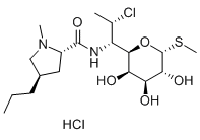 |
| CAS Number | 21462-39-5 |
| Molecular Formula | C18H34Cl2N2O5S |
| Molecular Weight | 461.4 g/mol |
| InChIKey | AUODDLQVRAJAJM-XJQDNNTCSA-N |
| SMILES | Available on request where applicable |
| Appearance | White to off-white crystalline powder |
| Purity / Grade | By agreed specification and batch COA |
| Storage | Room temperature |
Clindamycin Hydrochloride (CAS 21462-39-5) is a lincosamide antibiotic with the formula C₁₈H₃₃ClN₂O₅S·HCl (MW 461.44). Clindamycin inhibits bacterial protein synthesis by binding to the 50S ribosomal subunit. It has excellent activity against anaerobes and Gram-positive cocci and achieves high bone and soft tissue concentrations.
TCS Industries Limited, a Hong Kong-based trading and sourcing company, supplies Clindamycin HCl API in pharmaceutical grade for global procurement programs.
> Applications
Anaerobic infections and MRSA skin infections
Clindamycin 150–450 mg orally every 6–8 hours (or 600–900 mg IV every 8 hours) is used for skin and soft tissue infections, bone and joint infections, dental infections, intra-abdominal infections (combined with a Gram-negative agent), and as a beta-lactam alternative in penicillin-allergic patients. It is effective against community-acquired MRSA (CA-MRSA) skin infections. Lell et al. (Clin Infect Dis, 2003, 37:1461–1466) studied the pharmacokinetics of clindamycin and its bone penetration properties that support its use in osteomyelitis and dental infections.
Topical dermatological use
Topical clindamycin 1% (phosphate form) is used for acne vulgaris, often combined with benzoyl peroxide or tretinoin. It reduces Cutibacterium acnes (formerly P. acnes) colonization and inflammatory acne lesions.
> Sourcing & Supply
TCS Industries Limited supports development, qualification and commercial purchasing discussions for Clindamycin HCl with buyers in Australia, New Zealand, Canada and South Korea.
- Evaluation and commercial quantities: 500 g samples for formulation development; 5 kg and 25 kg for production. Pharmaceutical (USP/Ph.Eur.) grade. Oral and topical grades. Clindamycin phosphate also available for parenteral/topical use. DMF reference letters provided.
- Pallet quantities and production campaigns: repeat supply is coordinated against packaging, lead time, annual demand and destination-market import requirements.
> Quality & Documentation
Key specification parameters include assay (≥90.0% clindamycin equivalents), related substances (lincomycin ≤2.5%), specific optical rotation, loss on drying, heavy metals, residual solvents, and microbial limits. White to off-white crystalline powder. Freely soluble in water. Hygroscopic. Identity by HPLC and IR. Meets USP (Clindamycin Hydrochloride), Ph.Eur. (Clindamycini hydrochloridum), and BP. COA and MSDS are standard.
> Packaging
Clindamycin HCl is a white to off-white hygroscopic crystalline powder. Standard packaging includes double PE-lined foil bags in fibre drums (500 g, 1 kg, 5 kg, or 25 kg). Store at controlled room temperature (15–25 °C). Protect from moisture. Shelf life is typically 36 months. Labels and documents are checked before dispatch.
> Pricing & MOQ
Pricing is quoted by specification, packaging and destination. Common commercial discussions use 25 kg bag/drum formats, pallet quantities and production-campaign planning; smaller samples may be reviewed for qualified formulation teams.
> Regulatory & Compounding Context
Clindamycin HCl is monographed in USP, Ph.Eur. (Clindamycini hydrochloridum), and BP. FDA-approved in 1970 (Cleocin). Topical products (Cleocin T, BenzaClin, Acanya) approved. On the WHO Model List of Essential Medicines. Off-patent with extensive generic availability. DMF support available.
> Alias Index
- INN: Clindamycin
- CAS Number: 21462-39-5 (HCl); 24729-96-2 (phosphate)
- Formula: C₁₈H₃₃ClN₂O₅S·HCl (MW 461.44)
- Brand names: Cleocin, Dalacin
- ATC code: J01FF01 (systemic), D10AF01 (topical)
- Related: Lincomycin (parent compound)
- Commercial request terms: clindamycin HCl API, Cleocin generic, lincosamide antibiotic, acne API, TCS Industries Limited
> FAQ
What is the C. difficile risk?
Clindamycin is historically associated with Clostridioides difficile colitis. It disrupts anaerobic gut flora, allowing C. difficile overgrowth. The risk is higher in elderly, hospitalized patients, and with prolonged use. Antibiotic stewardship programs often restrict clindamycin use in hospitals for this reason. However, community-acquired C. difficile risk is lower.
What documents are available for Clindamycin HCl orders?
COA and MSDS are standard for commercial discussions. COO, packing list, invoice and other import-support documents can be arranged according to order scope.
Do you supply Clindamycin HCl to Australia and Canada?
Yes. We support B2B buyers in Australia, New Zealand, Canada and South Korea, subject to route and document review.
Do you supply New Zealand and South Korea?
Yes. We review Australia, New Zealand, Canada and South Korea for project supply, import documents, packaging and logistics planning before quotation.
How does Clindamycin penetrate bone?
Clindamycin achieves bone concentrations approximately 40–70% of serum levels — higher than most antibiotics. Its high lipophilicity and active bone uptake make it a preferred agent for osteomyelitis (especially S. aureus), dental infections, and prosthetic joint infections, particularly in penicillin-allergic patients.
What is inducible Clindamycin resistance?
Some erythromycin-resistant S. aureus carry the ermB gene that can be induced to also resist clindamycin. The D-zone test (erythromycin and clindamycin discs placed nearby on agar) detects this inducible resistance. If the D-zone test is positive, clindamycin should not be used as monotherapy because resistance may develop during treatment.
Can you arrange samples before commercial purchasing?
Samples or evaluation quantities may be reviewed for qualified buyers after target specification, application and destination-market requirements are clarified.
How is Clindamycin HCl packaged for export?
Packaging is confirmed by quantity and material properties. Typical options include foil bags, HDPE containers, fibre drums, 25 kg bags or palletized export packaging.
Can buyer-defined specifications be reviewed?
Yes. Send the specification, methods, impurity limits and required documents. TCS can review feasibility before confirming quotation and lead time.
What payment terms are normally used?
Standard payment is 100% T/T before dispatch unless a different arrangement has been approved for an established commercial account.
What lead time should buyers expect?
Lead time depends on stock, batch size, document scope and destination. Available stock can move faster; made-to-order or pallet programs require longer planning.
Is a DMF available?
Yes. TCS sources clindamycin HCl from manufacturers who maintain active DMFs with the FDA and ASMF/CEP with EMA. Off-patent with extensive generic competition. COA, stability data, and DMF reference letters provided.
Last reviewed: June 2026
Evaluation and research orders (≤10 kg) are shipped with COA, MSDS, and certificate of origin. Bulk commercial orders (>10 kg) qualify for volume pricing with a full technical documentation package available on request.
> Request a Quote
If your team already has a target application, estimated quantity, destination market, or documentation requirements, send those details so the commercial response can be prepared more efficiently.