
TCS Industries Limited (China-sourced API supplier) supplies Maropitant — API CAS 147116-67-4 for pharmaceutical B2B procurement — COA, MSDS, and technical documentation available on request.
> Overview
| Product Name | Maropitant |
|---|---|
| Structural Formula | 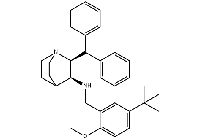 |
| CAS Number | 147116-67-4 |
| Molecular Formula | C₃₂H₄₀N₂O |
| Molecular Weight | 468.7 g/mol |
| InChIKey | OMPCVMLFFSQFIX-CONSDPRKSA-N |
| SMILES | Available on request where applicable |
| Appearance | White to off-white powder |
| Purity / Grade | By agreed specification and batch COA |
| Storage | Room temperature |
Maropitant Citrate (CAS 147116-67-4, as citrate salt) is a neurokinin-1 (NK₁) receptor antagonist with the formula C₃₂H₄₀N₂O₂ (free base MW 488.66). It selectively blocks substance P binding to the NK₁ receptor in the vomiting center and chemoreceptor trigger zone. Maropitant is the first veterinary-specific antiemetic and is used for motion sickness and acute vomiting in dogs and cats.
TCS Industries Limited, a Hong Kong-based trading and sourcing company, supplies Maropitant (citrate salt form for oral products, free base or citrate for injectable) for veterinary antiemetic formulation programs.
> Applications
Prevention and treatment of vomiting in dogs
Maropitant citrate is formulated as oral tablets (Cerenia, Zoetis) at 16, 24, 60 and 160 mg strengths, dosed at 2 mg/kg once daily for up to 5 consecutive days. It prevents vomiting from motion sickness (dosed at 8 mg/kg) and treats acute vomiting from multiple causes including chemotherapy-induced emesis, parvoviral enteritis and post-surgical nausea. Ramsey et al. (JAVMA, 2008, 232:535–541) demonstrated efficacy in motion sickness prevention.
Injectable antiemetic for hospitalized animals
Maropitant injectable solution (10 mg/mL, Cerenia injection) is administered subcutaneously at 1 mg/kg for rapid antiemetic effect in dogs and cats that cannot take oral medication. The injectable route provides onset within 15 minutes. Injection-site pain is a known issue; formulations use pH adjustment and metacresol as preservative. Refrigerated storage (2–8 °C) is required for the injectable form.
> Sourcing & Supply
TCS Industries Limited supports development, qualification and commercial purchasing discussions for Maropitant with buyers in Australia, New Zealand, Canada and South Korea.
- Development and qualification quantities: 50 g to 2 kg packs for formulation trials, stability studies, and veterinary drug registration submissions. Citrate salt and free base forms available.
- Pallet quantities and production campaigns: repeat supply is coordinated against packaging, lead time, annual demand and destination-market import requirements.
> Quality & Documentation
Key specification parameters include assay (≥98.0%), related substances, loss on drying, residue on ignition, heavy metals, residual solvents, and microbial limits. White to off-white crystalline powder (as citrate salt). Slightly soluble in water. Identity by HPLC and IR. Meets in-house veterinary pharmaceutical specifications. COA and MSDS are standard.
> Packaging
Maropitant citrate is a white to off-white crystalline powder. Standard packaging includes sealed foil bags in fibre drums (50 g, 100 g, 500 g, or 1 kg). Store at controlled room temperature (15–25 °C). Protect from light. Shelf life is typically 36 months. Labels and documents are checked before dispatch.
> Pricing & MOQ
Pricing is quoted by specification, packaging and destination. Common commercial discussions use 25 kg bag/drum formats, pallet quantities and production-campaign planning; smaller samples may be reviewed for qualified formulation teams.
> Regulatory & Compounding Context
Maropitant citrate is approved for veterinary use only. FDA-CVM approved in 2007 (Cerenia, Zoetis) for dogs; approved for cats in 2012. EMA-authorized. Not approved for human use (aprepitant is the human NK₁ antagonist). Injectable and oral tablet formulations available. Regulatory documentation available.
> Alias Index
- INN: Maropitant
- CAS Number: 147116-67-4 (citrate)
- Formula: C₃₂H₄₀N₂O₂ (free base MW 488.66)
- Brand name: Cerenia (Zoetis)
- ATCvet code: QA04AD90
- Pharmacological class: NK₁ receptor antagonist (substance P blocker)
- Related: Aprepitant (human NK₁ antagonist, Emend)
- Commercial request terms: maropitant citrate API, Cerenia generic, veterinary antiemetic, NK1 antagonist, TCS Industries Limited
> FAQ
Is Maropitant available as free base and citrate salt?
Yes. TCS can source both forms. Maropitant citrate is used in oral tablet formulations (Cerenia tablets). The salt form, purity, and particle size should be specified at inquiry to match the target formulation. Injectable formulations may use either form depending on pH and solubility requirements.
What documents are available for Maropitant orders?
COA and MSDS are standard for commercial discussions. COO, packing list, invoice and other import-support documents can be arranged according to order scope.
Do you supply Maropitant to Australia and Canada?
Yes. We support B2B buyers in Australia, New Zealand, Canada and South Korea, subject to route and document review.
Do you supply New Zealand and South Korea?
Yes. We review Australia, New Zealand, Canada and South Korea for project supply, import documents, packaging and logistics planning before quotation.
Is Maropitant approved for cats?
Yes. Maropitant injectable (Cerenia) is approved for prevention of vomiting in cats. The oral tablet form is currently approved for dogs only in most markets. Off-label oral use in cats has been reported. Buyers developing feline formulations should confirm species-specific registration pathways for their target market.
Does Maropitant prevent motion sickness in dogs?
Yes. Maropitant citrate dosed at 8 mg/kg orally (higher than the standard 2 mg/kg antiemetic dose) prevents motion sickness-induced vomiting in dogs. It should be administered at least 2 hours before travel on an empty stomach. This is the only FDA-CVM-approved treatment for canine motion sickness.
Can you arrange samples before commercial purchasing?
Samples or evaluation quantities may be reviewed for qualified buyers after target specification, application and destination-market requirements are clarified.
How is Maropitant packaged for export?
Packaging is confirmed by quantity and material properties. Typical options include foil bags, HDPE containers, fibre drums, 25 kg bags or palletized export packaging.
Can buyer-defined specifications be reviewed?
Yes. Send the specification, methods, impurity limits and required documents. TCS can review feasibility before confirming quotation and lead time.
What payment terms are normally used?
Standard payment is 100% T/T before dispatch unless a different arrangement has been approved for an established commercial account.
What lead time should buyers expect?
Lead time depends on stock, batch size, document scope and destination. Available stock can move faster; made-to-order or pallet programs require longer planning.
How does Maropitant compare to Metoclopramide for vomiting in dogs?
Maropitant (NK1 antagonist) and metoclopramide (dopamine D2 antagonist + 5-HT4 agonist) work through different mechanisms. Maropitant is effective against both central and peripheral emetic stimuli, including motion sickness and chemotherapy-induced emesis. Metoclopramide also has prokinetic activity. They are complementary and sometimes used together. Specify which compound is required.
Last reviewed: June 2026
Evaluation and research orders (≤10 kg) are shipped with COA, MSDS, and certificate of origin. Bulk commercial orders (>10 kg) qualify for volume pricing with a full technical documentation package available on request.
> Request a Quote
If your team already has a target application, estimated quantity, destination market, or documentation requirements, send those details so the commercial response can be prepared more efficiently.