
TCS Industries Limited (China-sourced API supplier) supplies Cyanocobalamin — API CAS 68-19-9 for pharmaceutical B2B procurement — COA, MSDS, and technical documentation available on request.
> Overview
| Product Name | Cyanocobalamin |
|---|---|
| Structural Formula | 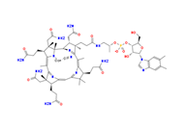 |
| CAS Number | 68-19-9 |
| Molecular Formula | C63H88CoN14O14P |
| Molecular Weight | 1355.4 g/mol |
| InChIKey | FDJOLVPMNUYSCM-SYUKHSAKSA-L |
| SMILES | Available on request where applicable |
| Appearance | Dark red crystalline powder or crystals |
| Purity / Grade | By agreed specification and batch COA |
| Storage | Room temperature, protect from light and moisture |
Cyanocobalamin (CAS 68-19-9) is the synthetic form of vitamin B12 with the formula C₆₃H₈₈CoN₁₄O₁₄P (MW 1355.37). It is a widely used and chemically stable form of vitamin B12 in pharmaceutical and food fortification applications. Cyanocobalamin is produced by bacterial fermentation (Pseudomonas denitrificans or Propionibacterium freudenreichii) followed by cyanide addition to stabilize the molecule for long-term storage.
TCS Industries Limited, a Hong Kong-based trading and sourcing company, supplies Cyanocobalamin in pharmaceutical (USP/Ph.Eur.) and food grades for global procurement programs.
> Applications
Treatment of vitamin B12 deficiency and pernicious anemia
Cyanocobalamin is the standard pharmacopoeial form of B12 used in oral tablets, sublingual preparations, nasal sprays, and injectable (IM/SC) formulations for treatment of megaloblastic anemia, pernicious anemia, and neurological complications of B12 deficiency. Pharmaceutical formulations range from 100 mcg oral tablets to 1000 mcg/mL injection solutions. Stabler et al. (N Engl J Med, 2013, 368:149–160) reviewed the clinical diagnosis and treatment of vitamin B12 deficiency.
Food fortification and nutritional supplementation
Cyanocobalamin is the preferred B12 form for food fortification (flour, cereals, plant-based milk alternatives) due to its superior stability compared to methylcobalamin and adenosylcobalamin. It is stable in aqueous solution, heat-resistant during food processing, and has an established regulatory profile in all major markets. Typical fortification levels are 0.4–2.4 mcg per serving.
> Sourcing & Supply
TCS Industries Limited supports development, qualification and commercial purchasing discussions for Cyanocobalamin with buyers in Australia, New Zealand, Canada and South Korea.
- Evaluation and commercial quantities: sample vials for qualification; 1 kg to 25 kg packaging for production. USP/Ph.Eur. pharma grade and food grade available. Produced by fermentation.
- Pallet quantities and production campaigns: repeat supply is coordinated against packaging, lead time, annual demand and destination-market import requirements.
> Quality & Documentation
Key specification parameters include assay (≥96.0% on dried basis per USP/Ph.Eur.), loss on drying (≤12.0%), related substances (hydroxocobalamin, aquocobalamin), residual solvents, heavy metals, and microbial limits. UV-Vis absorption at 278 nm, 361 nm, and 550 nm confirms identity. The dark red crystalline powder should be freely soluble in water. COA and MSDS are standard.
> Packaging
Cyanocobalamin is more light-stable than methylcobalamin but still benefits from protection against prolonged UV exposure. Standard packaging includes amber glass bottles, aluminum foil bags, or PE/Al/PE bags in fibre drums. Store at controlled room temperature (15–25 °C) protected from light and moisture. Labels and documents are checked before dispatch.
> Pricing & MOQ
Pricing is quoted by specification, packaging and destination. Common commercial discussions use 25 kg bag/drum formats, pallet quantities and production-campaign planning; smaller samples may be reviewed for qualified formulation teams.
> Regulatory & Compounding Context
Cyanocobalamin is monographed in USP, BP, Ph.Eur. (Cyanocobalaminum), JP and all major pharmacopoeias. On the WHO Model List of Essential Medicines. Listed in the FDA IID. Authorized as a vitamin B12 source in food supplements (EU Directive 2002/46/EC) and food fortification programs globally. GRAS in the US (21 CFR 184.1945). No special import permits for pharmaceutical or food-grade material.
> Alias Index
- IUPAC: Cyanocobalamin
- CAS Number: 68-19-9
- Formula: C₆₃H₈₈CoN₁₄O₁₄P (MW 1355.37)
- Pharmacopoeial name: Cyanocobalaminum (Ph.Eur.)
- Common names: Vitamin B12, VB12, Cobalamin
- InChIKey: RMRCNWBMXRMIRW-UHFFFAOYSA-N
- Commercial request terms: cyanocobalamin USP, vitamin B12 API, VB12 pharma grade, cobalamin food grade, TCS Industries Limited
> FAQ
Why is Cyanocobalamin the standard pharmaceutical B12 form?
Cyanocobalamin is a chemically stable B12 vitamer, resistant to light, heat and oxidation during food processing and pharmaceutical manufacturing. It has monographs in all major pharmacopoeias and a long regulatory track record. This stability advantage is the primary reason for its dominance in fortification and pharmaceutical products.
What documents are available for Cyanocobalamin orders?
COA and MSDS are standard for commercial discussions. COO, packing list, invoice and other import-support documents can be arranged according to order scope.
Do you supply Cyanocobalamin to Australia and Canada?
Yes. We support B2B buyers in Australia, New Zealand, Canada and South Korea, subject to route and document review.
Do you supply New Zealand and South Korea?
Yes. We review Australia, New Zealand, Canada and South Korea for project supply, import documents, packaging and logistics planning before quotation.
Is Cyanocobalamin on the WHO Essential Medicines List?
Yes. Cyanocobalamin (injection and oral) is on the WHO Model List of Essential Medicines for treatment of megaloblastic anemia and B12 deficiency. Pharmaceutical-grade material must meet USP or Ph.Eur. specifications.
Is Cyanocobalamin produced synthetically or by fermentation?
Cyanocobalamin is produced by bacterial fermentation using Pseudomonas denitrificans or Propionibacterium freudenreichii, followed by cyanide addition to the corrin ring. Total chemical synthesis is not commercially viable due to the structural complexity of the B12 molecule.
Can you arrange samples before commercial purchasing?
Samples or evaluation quantities may be reviewed for qualified buyers after target specification, application and destination-market requirements are clarified.
How is Cyanocobalamin packaged for export?
Packaging is confirmed by quantity and material properties. Typical options include foil bags, HDPE containers, fibre drums, 25 kg bags or palletized export packaging.
Can buyer-defined specifications be reviewed?
Yes. Send the specification, methods, impurity limits and required documents. TCS can review feasibility before confirming quotation and lead time.
What payment terms are normally used?
Standard payment is 100% T/T before dispatch unless a different arrangement has been approved for an established commercial account.
What lead time should buyers expect?
Lead time depends on stock, batch size, document scope and destination. Available stock can move faster; made-to-order or pallet programs require longer planning.
What is the difference between Cyanocobalamin and Hydroxocobalamin?
Cyanocobalamin (CAS 68-19-9) carries a cyanide group and is used for oral B12 supplementation. Hydroxocobalamin (CAS 13422-51-0) carries a hydroxyl group and is used as a cyanide antidote (intravenous) and for B12 injection therapy. They are different compounds with different CAS numbers and clinical applications.
Last reviewed: June 2026
Evaluation and research orders (≤10 kg) are shipped with COA, MSDS, and certificate of origin. Bulk commercial orders (>10 kg) qualify for volume pricing with a full technical documentation package available on request.
> Request a Quote
If your team already has a target application, estimated quantity, destination market, or documentation requirements, send those details so the commercial response can be prepared more efficiently.