
TCS Industries Limited (China-sourced API supplier) supplies Chloramphenicol — API CAS 56-75-7 for pharmaceutical B2B procurement — COA, MSDS, and technical documentation available on request.
> Overview
| Product Name | Chloramphenicol |
|---|---|
| Structural Formula | 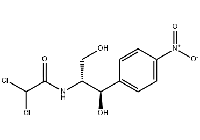 |
| CAS Number | 56-75-7 |
| Molecular Formula | C₁₁H₁₂Cl₂N₂O₅ |
| Molecular Weight | 323.13 g/mol |
| InChIKey | WIIZWVCIJKGZOK-RKDXNWHRSA-N |
| SMILES | Available on request where applicable |
| Appearance | White to greyish-white or yellowish-white crystalline powder |
| Purity / Grade | By agreed specification and batch COA |
| Storage | Room temperature, protect from light |
Chloramphenicol (CAS 56-75-7) is a broad-spectrum antibiotic with the formula C₁₁H₁₂Cl₂N₂O₅ (MW 323.13). Originally isolated from Streptomyces venezuelae, it is now produced synthetically. Chloramphenicol inhibits bacterial protein synthesis by binding to the 50S ribosomal subunit and blocking peptidyl transferase. It is used for serious infections where alternatives are unavailable and for topical ophthalmic use.
TCS Industries Limited, a Hong Kong-based trading and sourcing company, supplies Chloramphenicol API in pharmaceutical grade for global procurement programs.
> Applications
Serious infections and topical ophthalmic use
Systemic chloramphenicol (IV 50–100 mg/kg/day in divided doses) is reserved for serious infections (bacterial meningitis, typhoid fever, rickettsial infections) where beta-lactams and other antibiotics cannot be used. Topical chloramphenicol 0.5% eye drops and 1% ointment are available OTC in some markets for bacterial conjunctivitis. Yunis et al. (Am J Med, 1973, 54:196–208) described the two mechanisms of chloramphenicol-induced bone marrow suppression and established the distinction between dose-dependent marrow depression and idiosyncratic aplastic anemia.
Developing world essential medicine
Chloramphenicol remains important in resource-limited settings for typhoid fever (where fluoroquinolone resistance is emerging), bacterial meningitis, and plague. It is on the WHO Model List of Essential Medicines. Its low cost and broad spectrum maintain its relevance despite toxicity concerns.
> Sourcing & Supply
TCS Industries Limited supports development, qualification and commercial purchasing discussions for Chloramphenicol with buyers in Australia, New Zealand, Canada and South Korea.
- Evaluation and commercial quantities: 1 kg samples for formulation development; 5 kg and 25 kg for production. Pharmaceutical (USP/Ph.Eur.) grade. Synthetic API. Ophthalmic and systemic grades. DMF reference letters available.
- Pallet quantities and production campaigns: repeat supply is coordinated against packaging, lead time, annual demand and destination-market import requirements.
> Quality & Documentation
Key specification parameters include assay (≥98.0%), related substances, specific optical rotation, loss on drying, residue on ignition, heavy metals, residual solvents, and microbial limits. White to greyish-white or yellowish-white crystalline powder. Slightly soluble in water, freely soluble in ethanol and propylene glycol. Bitter taste. Identity by HPLC, IR, and specific optical rotation. Meets USP (Chloramphenicol), Ph.Eur. (Chloramphenicolum), and BP. COA and MSDS are standard.
> Packaging
Chloramphenicol is a white to greyish-white crystalline powder. Standard packaging includes double PE-lined foil bags in fibre drums (1 kg, 5 kg, or 25 kg). Store at controlled room temperature (15–25 °C). Protect from light. Shelf life is typically 36 months. Labels and documents are checked before dispatch.
> Pricing & MOQ
Pricing is quoted by specification, packaging and destination. Common commercial discussions use 25 kg bag/drum formats, pallet quantities and production-campaign planning; smaller samples may be reviewed for qualified formulation teams.
> Regulatory & Compounding Context
Chloramphenicol is monographed in USP, Ph.Eur. (Chloramphenicolum), BP, and JP. FDA-approved (Chloromycetin). On the WHO Model List of Essential Medicines. Topical ophthalmic products available OTC in the UK and other markets. Banned in food-producing animals in the US and EU due to aplastic anemia risk. DMF support available.
> Alias Index
- INN: Chloramphenicol
- CAS Number: 56-75-7
- Formula: C₁₁H₁₂Cl₂N₂O₅ (MW 323.13)
- Brand name: Chloromycetin
- ATC code: J01BA01 (systemic), S01AA01 (ophthalmic), D06AX02 (topical)
- Source: Synthetic (originally Streptomyces venezuelae)
- Commercial request terms: chloramphenicol API, Chloromycetin generic, topical antibiotic eye drops, TCS Industries Limited
> FAQ
Why is systemic Chloramphenicol rarely used?
Chloramphenicol carries a risk of idiosyncratic aplastic anemia (1 in 20,000–40,000 patients), which is dose-independent, unpredictable, and often fatal. Separate dose-dependent bone marrow suppression (reversible) also occurs. These risks have made it a last-resort antibiotic in developed countries, replaced by safer alternatives where available.
What documents are available for Chloramphenicol orders?
COA and MSDS are standard for commercial discussions. COO, packing list, invoice and other import-support documents can be arranged according to order scope.
Do you supply Chloramphenicol to Australia and Canada?
Yes. We support B2B buyers in Australia, New Zealand, Canada and South Korea, subject to route and document review.
Do you supply New Zealand and South Korea?
Yes. We review Australia, New Zealand, Canada and South Korea for project supply, import documents, packaging and logistics planning before quotation.
Is topical Chloramphenicol safe?
Topical ophthalmic chloramphenicol (0.5% drops, 1% ointment) has minimal systemic absorption. The aplastic anemia risk from topical use is extremely low (estimated <1 per million courses). It is available OTC in the UK for bacterial conjunctivitis. Topical use is considered safe by most regulatory authorities.
Why is Chloramphenicol banned in food animals?
Chloramphenicol is banned in food-producing animals in the US, EU, and many other jurisdictions because no safe residue level can be established for the idiosyncratic aplastic anemia risk. Zero tolerance is applied for chloramphenicol residues in food. Testing for chloramphenicol residues is part of food safety monitoring programs.
Can you arrange samples before commercial purchasing?
Samples or evaluation quantities may be reviewed for qualified buyers after target specification, application and destination-market requirements are clarified.
How is Chloramphenicol packaged for export?
Packaging is confirmed by quantity and material properties. Typical options include foil bags, HDPE containers, fibre drums, 25 kg bags or palletized export packaging.
Can buyer-defined specifications be reviewed?
Yes. Send the specification, methods, impurity limits and required documents. TCS can review feasibility before confirming quotation and lead time.
What payment terms are normally used?
Standard payment is 100% T/T before dispatch unless a different arrangement has been approved for an established commercial account.
What lead time should buyers expect?
Lead time depends on stock, batch size, document scope and destination. Available stock can move faster; made-to-order or pallet programs require longer planning.
Is a DMF available?
Yes. TCS sources chloramphenicol from synthetic manufacturers who maintain active DMFs. Pharmaceutical-grade material meeting USP/Ph.Eur. specifications. COA, stability data, and DMF reference letters are provided.
Last reviewed: June 2026
Evaluation and research orders (≤10 kg) are shipped with COA, MSDS, and certificate of origin. Bulk commercial orders (>10 kg) qualify for volume pricing with a full technical documentation package available on request.
> Request a Quote
If your team already has a target application, estimated quantity, destination market, or documentation requirements, send those details so the commercial response can be prepared more efficiently.