
TCS Industries Limited (China-sourced API supplier) supplies Mycophenolic Acid — API CAS 24280-93-1 for pharmaceutical B2B procurement — COA, MSDS, and technical documentation available on request.
> Overview
| Product Name | Mycophenolic Acid |
|---|---|
| Structural Formula | 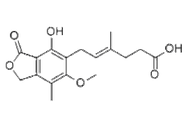 |
| CAS Number | 24280-93-1 |
| Molecular Formula | C17H20O6 |
| Molecular Weight | 320.3 g/mol |
| InChIKey | HPNSFSBZBAHARI-RUDMXATFSA-N |
| SMILES | Available on request where applicable |
| Appearance | White to off-white crystalline powder |
| Purity / Grade | By agreed specification and batch COA |
| Storage | Store at controlled room temperature, protect from moisture |
Mycophenolic Acid (CAS 24280-93-1, MPA) is an immunosuppressant produced by Penicillium stoloniferum with the formula C₁₇H₂₀O₆ (MW 320.34). MPA selectively inhibits inosine monophosphate dehydrogenase (IMPDH), blocking de novo guanosine nucleotide synthesis in lymphocytes. It is used as mycophenolate mofetil (prodrug) or mycophenolate sodium (enteric-coated) for organ transplant rejection prevention.
TCS Industries Limited, a Hong Kong-based trading and sourcing company, supplies Mycophenolic Acid and Mycophenolate Mofetil API in pharmaceutical grade for global procurement programs.
> Applications
Transplant immunosuppression
Mycophenolic acid inhibits IMPDH type II (lymphocyte isoform) 5× more potently than type I, providing selective immunosuppression. Lymphocytes are uniquely dependent on the de novo guanosine pathway (lacking the salvage pathway), making MPA selectively lymphocyte-suppressive. Mycophenolate mofetil 1–1.5 g twice daily is standard in combination with tacrolimus and corticosteroids. Allison et al. (Transplantation, 2005, 80:S181–S190) reviewed the mechanism by which mycophenolic acid selectively targets lymphocyte proliferation through IMPDH inhibition and the de novo purine synthesis pathway.
Autoimmune disease applications
Mycophenolate is used off-label for lupus nephritis, autoimmune hepatitis, myasthenia gravis, and pemphigus. It provides effective immunosuppression with a more favorable side-effect profile than cyclophosphamide for many autoimmune indications.
> Sourcing & Supply
TCS Industries Limited supports development, qualification and commercial purchasing discussions for Mycophenolic Acid with buyers in Australia, New Zealand, Canada and South Korea.
- Evaluation and commercial quantities: 100 g samples for analytical qualification; 1 kg and 5 kg for production. Available as mycophenolic acid (free acid) and mycophenolate mofetil (prodrug). DMF reference letters provided.
- Pallet quantities and production campaigns: repeat supply is coordinated against packaging, lead time, annual demand and destination-market import requirements.
> Quality & Documentation
Key specification parameters include assay (≥98.0%), related substances, specific optical rotation, water content, residual solvents, heavy metals, and microbial limits. White to off-white crystalline powder. Slightly soluble in water, soluble in methanol and acetone. Identity by HPLC and IR. Available as mycophenolic acid (free acid) and mycophenolate mofetil (morpholinoethyl ester prodrug). Meets USP (Mycophenolic Acid, Mycophenolate Mofetil) and Ph.Eur. COA and MSDS are standard.
> Packaging
Mycophenolic acid and mycophenolate mofetil are white to off-white powders. Standard packaging includes double PE-lined foil bags in fibre drums (1 kg, 5 kg, or 25 kg). Store at controlled room temperature (15–25 °C). Protect from moisture. Shelf life is typically 36 months. Labels and documents are checked before dispatch.
> Pricing & MOQ
Pricing is quoted by specification, packaging and destination. Common commercial discussions use 25 kg bag/drum formats, pallet quantities and production-campaign planning; smaller samples may be reviewed for qualified formulation teams.
> Regulatory & Compounding Context
Mycophenolate mofetil is monographed in USP and Ph.Eur. FDA-approved in 1995 (CellCept). Mycophenolate sodium enteric-coated (Myfortic) approved in 2004. EMA-authorized. On the WHO Model List of Essential Medicines. Multiple generic approvals. DMF support available from qualified manufacturers.
> Alias Index
- INN: Mycophenolic acid (MPA); Mycophenolate mofetil (MMF, prodrug)
- CAS Number: 24280-93-1 (MPA); 128794-94-5 (MMF)
- Formula: C₁₇H₂₀O₆ (MPA, MW 320.34)
- Brand names: CellCept (MMF), Myfortic (mycophenolate sodium EC)
- ATC code: L04AA06
- Target: IMPDH (inosine monophosphate dehydrogenase)
- Commercial request terms: mycophenolic acid API, mycophenolate mofetil, CellCept generic, IMPDH inhibitor, TCS Industries Limited
> FAQ
What is the difference between CellCept and Myfortic?
CellCept (mycophenolate mofetil): morpholinoethyl ester prodrug, hydrolyzed to MPA in the gut and plasma. Myfortic (mycophenolate sodium): enteric-coated MPA sodium salt, designed to reduce upper GI side effects. Both deliver MPA as the active moiety. They are NOT bioequivalent and cannot be substituted milligram-for-milligram.
What documents are available for Mycophenolic Acid orders?
COA and MSDS are standard for commercial discussions. COO, packing list, invoice and other import-support documents can be arranged according to order scope.
Do you supply Mycophenolic Acid to Australia and Canada?
Yes. We support B2B buyers in Australia, New Zealand, Canada and South Korea, subject to route and document review.
Do you supply New Zealand and South Korea?
Yes. We review Australia, New Zealand, Canada and South Korea for project supply, import documents, packaging and logistics planning before quotation.
Why is IMPDH inhibition selective for lymphocytes?
Most cells use both de novo and salvage pathways for guanosine nucleotide synthesis. Lymphocytes primarily depend on the de novo pathway (low HGPRT salvage activity). MPA blocks de novo synthesis via IMPDH inhibition, selectively depleting guanosine in lymphocytes. Other cell types compensate via the salvage pathway, reducing off-target effects.
Is therapeutic drug monitoring recommended?
TDM for MPA is optional but increasingly used. Target AUC₀₋₁₂ is 30–60 mg·h/L. Trough levels (C₀ ~1–3.5 mg/L) correlate less well with efficacy than AUC. MPA pharmacokinetics are highly variable due to enterohepatic recirculation. Limited sampling strategies (2–3 time points) can estimate AUC. TDM is recommended for dose optimization and in high-risk patients.
Can you arrange samples before commercial purchasing?
Samples or evaluation quantities may be reviewed for qualified buyers after target specification, application and destination-market requirements are clarified.
How is Mycophenolic Acid packaged for export?
Packaging is confirmed by quantity and material properties. Typical options include foil bags, HDPE containers, fibre drums, 25 kg bags or palletized export packaging.
Can buyer-defined specifications be reviewed?
Yes. Send the specification, methods, impurity limits and required documents. TCS can review feasibility before confirming quotation and lead time.
What payment terms are normally used?
Standard payment is 100% T/T before dispatch unless a different arrangement has been approved for an established commercial account.
What lead time should buyers expect?
Lead time depends on stock, batch size, document scope and destination. Available stock can move faster; made-to-order or pallet programs require longer planning.
Is a DMF available?
Yes. TCS sources mycophenolate mofetil and mycophenolic acid from manufacturers who maintain active DMFs with the FDA and ASMF/CEP with EMA. Off-patent with extensive generic competition. COA, stability data, and DMF reference letters are provided.
Last reviewed: June 2026
Evaluation and research orders (≤10 kg) are shipped with COA, MSDS, and certificate of origin. Bulk commercial orders (>10 kg) qualify for volume pricing with a full technical documentation package available on request.
> Request a Quote
If your team already has a target application, estimated quantity, destination market, or documentation requirements, send those details so the commercial response can be prepared more efficiently.