
TCS Industries Limited supplies Carmustine CAS 154-93-8 for pharmaceutical B2B procurement — COA, MSDS, and technical documentation available on request.
> Overview
| Product Name | Carmustine |
|---|---|
| Structural Formula | 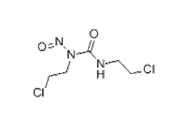 |
| CAS Number | 154-93-8 |
| Molecular Formula | C5H9Cl2N3O2 |
| Molecular Weight | 214.05 g/mol |
| InChIKey | DLGOEMSEDOSKAD-UHFFFAOYSA-N |
| SMILES | Available on request where applicable |
| Appearance | Light yellow to pale green powder or lyophilized solid |
| Purity / Grade | By agreed specification and batch COA |
| Storage | Store at 2–8°C, protect from light |
Carmustine (CAS 154-93-8, BCNU) is a nitrosourea alkylating agent with the formula C₅H₉Cl₂N₃O₂ (MW 214.05). Like lomustine, it is lipophilic and crosses the blood-brain barrier. Carmustine is used for brain tumors (glioblastoma, brain metastases), Hodgkin lymphoma, multiple myeloma, and as an implantable wafer (Gliadel) placed directly in the tumor resection cavity.
TCS Industries Limited, a Hong Kong-based company, supplies Carmustine API in pharmaceutical grade for global procurement programs.
> Applications
CNS tumor chemotherapy
Carmustine is administered IV at 150–200 mg/m² every 6 weeks for glioblastoma, medulloblastoma, and brain metastases. It alkylates DNA through chloroethyl carbonium ion intermediates, forming inter-strand cross-links. The Gliadel wafer (carmustine-impregnated biodegradable polymer) is placed directly in the surgical cavity after tumor resection, providing local sustained-release chemotherapy. Westphal et al. (Neuro Oncol, 2003, 5:79–88) demonstrated that carmustine wafer implantation after glioblastoma resection significantly extended overall survival compared to placebo wafers.
Lymphoma and myeloma conditioning
Carmustine is used in the BEAM conditioning regimen (BCNU, etoposide, cytarabine, melphalan) before autologous stem cell transplantation for relapsed Hodgkin and non-Hodgkin lymphoma. It is also used in multiple myeloma combination chemotherapy.
> Sourcing & Supply
TCS Industries Limited supports development, qualification and commercial purchasing discussions for Carmustine with buyers in Australia, New Zealand, Canada and South Korea.
- Evaluation and commercial quantities: 10 g samples for analytical qualification; 100 g and 1 kg for production. Cytotoxic API — cold chain required (store at -20 °C). DMF reference letters available.
- Pallet quantities and production campaigns: repeat supply is coordinated against packaging, lead time, annual demand and destination-market import requirements.
> Quality & Documentation
Key specification parameters include assay (≥98.0%), related substances, loss on drying, residual solvents, heavy metals, and microbial limits. Light yellow to pale green powder. Soluble in ethanol and lipids, slightly soluble in water. Thermally unstable — decomposes above 30 °C. Handle as cytotoxic material. Identity by HPLC and IR. Meets USP (Carmustine) and in-house pharmaceutical specifications. COA and MSDS are standard.
> Packaging
Carmustine is a light yellow to pale green powder, cytotoxic and thermally unstable. Must be stored at -20 °C. Standard packaging includes sealed glass vials or foil bags in insulated containers with dry ice shipment. Decomposes rapidly above 30 °C — temperature excursion monitoring required. Shelf life is typically 24 months at -20 °C. Labels and documents are checked before dispatch.
> Pricing & MOQ
Pricing is quoted by specification, packaging and destination. Common commercial discussions use 25 kg bag/drum formats, pallet quantities and production-campaign planning; smaller samples may be reviewed for qualified formulation teams.
> Regulatory & Compounding Context
Carmustine is monographed in USP. FDA-approved for IV injection (BiCNU) and as carmustine wafer implant (Gliadel). EMA-authorized. On the WHO Model List of Essential Medicines. Generic carmustine for injection available. Manufacturing requires cytotoxic handling facilities and cold chain. DMF support available.
> Alias Index
- INN: Carmustine
- CAS Number: 154-93-8
- Formula: C₅H₉Cl₂N₃O₂ (MW 214.05)
- Abbreviation: BCNU (bis-chloroethylnitrosourea)
- Brand names: BiCNU (IV), Gliadel (wafer implant)
- ATC code: L01AD01
- Related: Lomustine (CCNU, oral nitrosourea)
- Commercial request terms: carmustine API, BCNU bulk, nitrosourea alkylating agent, Gliadel wafer API, TCS Industries Limited
> FAQ
Why does Carmustine require frozen storage?
Carmustine is thermally unstable — it decomposes above 30 °C with a half-life of hours at room temperature. Storage at -20 °C preserves stability. The API and reconstituted IV solution must be kept cold. The BiCNU vial contains carmustine as a lyophilized powder reconstituted with ethanol/water diluent immediately before use.
What documents are available for Carmustine orders?
COA and MSDS are standard for commercial discussions. COO, packing list, invoice and other import-support documents can be arranged according to order scope.
Do you supply Carmustine to Australia and Canada?
Yes. We support B2B buyers in Australia, New Zealand, Canada and South Korea, subject to route and document review.
Do you supply New Zealand and South Korea?
Yes. We review Australia, New Zealand, Canada and South Korea for project supply, import documents, packaging and logistics planning before quotation.
What is the Gliadel wafer?
Gliadel is a biodegradable polymer wafer (polifeprosan 20) impregnated with 3.85% carmustine. Up to 8 wafers are placed in the resection cavity after brain tumor removal. The polymer slowly degrades over 2–3 weeks, releasing carmustine directly into surrounding brain tissue, bypassing the blood-brain barrier entirely.
How does Carmustine compare to Lomustine?
Both are nitrosourea alkylating agents that cross the BBB. Carmustine (BCNU) is administered IV; lomustine (CCNU) is oral. Carmustine has the Gliadel wafer formulation advantage. Lomustine is more convenient for outpatient use. Both cause delayed myelosuppression with 6-week dosing intervals. They are often considered interchangeable in CNS tumor regimens.
Can you arrange samples before commercial purchasing?
Samples or evaluation quantities may be reviewed for qualified buyers after target specification, application and destination-market requirements are clarified.
How is Carmustine packaged for export?
Packaging is confirmed by quantity and material properties. Typical options include foil bags, HDPE containers, fibre drums, 25 kg bags or palletized export packaging.
Can buyer-defined specifications be reviewed?
Yes. Send the specification, methods, impurity limits and required documents. TCS can review feasibility before confirming quotation and lead time.
What payment terms are normally used?
Standard payment is 100% T/T before dispatch unless a different arrangement has been approved for an established commercial account.
What lead time should buyers expect?
Lead time depends on stock, batch size, document scope and destination. Available stock can move faster; made-to-order or pallet programs require longer planning.
What is the BEAM conditioning regimen?
BEAM: BCNU (carmustine 300 mg/m² day -6) + Etoposide (200 mg/m² days -5 to -2) + Cytarabine (400 mg/m² days -5 to -2) + Melphalan (140 mg/m² day -1). This high-dose conditioning regimen is given before autologous stem cell rescue for relapsed Hodgkin and aggressive non-Hodgkin lymphoma.
Last reviewed: June 2026
Evaluation and research orders (≤10 kg) are shipped with COA, MSDS, and certificate of origin. Bulk commercial orders (>10 kg) qualify for volume pricing with a full technical documentation package available on request.
> Request a Quote
If your team already has a target application, estimated quantity, destination market, or documentation requirements, send those details so the commercial response can be prepared more efficiently.