
TCS Industries Limited (China-sourced API supplier) supplies Tannic Acid — Plant Extract CAS 1401-55-4 for pharmaceutical B2B procurement — COA, MSDS, and technical documentation available on request.
> Overview
| Product Name | Tannic Acid |
|---|---|
| Structural Formula | 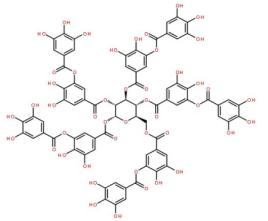 |
| CAS Number | 1401-55-4 |
| Molecular Formula | C76H52O46 |
| Molecular Weight | 1701.2 g/mol |
| InChIKey | LRBQNJMCXXYXIU-PPKXGCFTSA-N |
| SMILES | Available on request where applicable |
| Appearance | Yellowish-brown to light brown amorphous powder |
| Purity / Grade | By agreed specification and batch COA |
| Storage | Keep tightly closed in a cool, dry, well-ventilated place |
Tannic Acid (CAS 1401-55-4) is a naturally occurring polyphenolic compound, a specific form of hydrolyzable tannin consisting of gallic acid esters linked to a central glucose core. The approximate formula is C₇₆H₅₂O₄₆ (MW ~1701.2), though commercial tannic acid is a mixture of polygalloyl glucoses. It is extracted from plant sources (gallnuts, sumac, tara pods) and used in pharmaceutical compounding, analytical chemistry, food processing, leather tanning, and water treatment.
TCS Industries Limited, a Hong Kong-based trading and sourcing company, supplies Tannic Acid in pharmaceutical, analytical, food and technical grades for global procurement programs.
> Applications
Pharmaceutical and wound care applications
Tannic acid has astringent, hemostatic, and antimicrobial properties. It is used in topical preparations for minor burns, wound care, and hemorrhoid treatment. In pharmaceutical compounding, it is used as a protein precipitant and complexing agent. The astringent effect is due to cross-linking with tissue proteins. Lopes et al. (Molecules, 2017, 22:762) reviewed the biological activities and pharmaceutical applications of tannins including tannic acid.
Analytical reagent and industrial applications
ACS reagent-grade tannic acid is used in analytical chemistry for determination of albumin, gelatin, and alkaloids. In water treatment, it is used as a coagulant aid and corrosion inhibitor for steel surfaces. In the food industry, tannic acid is used as a clarifying agent for beer and wine production (fining agent). Industrial-grade material is used in leather tanning, ink manufacturing, and wood adhesive production.
> Sourcing & Supply
TCS Industries Limited supports development, qualification and commercial purchasing discussions for Tannic Acid with buyers in Germany, France, Italy, Spain, the United Kingdom, the United States, Canada and Australia.
- Evaluation samples: botanical identity, assay basis and document needs are reviewed before dispatch.
- Commercial lots: repeat supply is arranged by specification, extract ratio, marker compound and destination-market requirements.
> Quality & Documentation
Key specification parameters include tannin content (≥90% for pharmaceutical grade per USP), gallic acid content, moisture, ash, insoluble matter, heavy metals (Pb, As), and microbial limits. Analytical grade requires controlled iron content. Identity confirmed by characteristic yellow-brown amorphous powder, solubility in water and ethanol, and positive FeCl₃ test (blue-black precipitate). COA and MSDS are standard.
> Packaging
Tannic Acid is hygroscopic and oxidation-sensitive. Standard packaging includes 25 kg fibre drums with PE liner (pharmaceutical/analytical grade) or 25 kg woven PP bags (technical grade). Store in a cool, dry environment protected from moisture and light. Shelf life is typically 36 months when stored correctly. Labels and documents are checked before dispatch.
> Pricing & MOQ
Pricing is quoted by marker specification, extract ratio, packaging and destination. Samples, 25 kg packs and pallet quantities can be discussed according to project stage.
> Regulatory & Compounding Context
Tannic Acid is monographed in USP-NF (as an excipient). Listed in the FDA IID. GRAS in the US for food use as a flavoring agent (21 CFR 184.1097). Permitted as a food additive in the EU (E181) with restrictions. REACH-registered. Not classified as dangerous goods for transport. Buyers should specify grade (pharmaceutical, analytical, food, technical) and applicable standard at inquiry.
> Alias Index
- Chemical class: Hydrolyzable tannin (polygalloyl glucose)
- CAS Number: 1401-55-4
- Approximate formula: C₇₆H₅₂O₄₆ (MW ~1701)
- EU food additive: E181
- Common names: Gallotannic acid, Gallotannin, Tannin
- Natural sources: Gallnuts (Quercus infectoria), sumac, tara pods, chestnut
- InChIKey: LRBQNJMCXXYXIU-UHFFFAOYSA-N
- Commercial request terms: tannic acid USP, gallotannin, tannin reagent grade, E181, TCS Industries Limited
> FAQ
What grades of Tannic Acid does TCS supply?
TCS sources pharmaceutical (USP-NF), analytical (ACS reagent), food (FCC/E181), and technical grades. Each grade has different purity, heavy metal, and functional specifications. Specify the intended application and target standard at inquiry.
What documents are available for Tannic Acid orders?
COA and MSDS are standard for commercial discussions. COO, packing list, invoice and other import-support documents can be arranged according to order scope.
Do you supply Tannic Acid to Germany, France and Spain?
Yes. We support B2B buyers in Germany, France, Italy, Spain, the United Kingdom, the Netherlands, Poland and Switzerland, subject to route and document review.
Do you supply the United States, Canada and Australia?
Yes. We review the United States, Canada, Australia and New Zealand for project supply, import documents, packaging and logistics planning before quotation.
What is the tannin content specification?
Pharmaceutical-grade tannic acid typically has ≥90% tannin content per USP specifications. Analytical grade may specify higher purity (≥95%). Technical grade has lower purity requirements. Gallic acid content and ash are additional quality parameters.
Is Tannic Acid the same as tannin?
Tannic acid is a specific type of hydrolyzable tannin (polygalloyl glucose). The term “tannin” encompasses a broader class of polyphenolic compounds including both hydrolyzable tannins (tannic acid, ellagitannins) and condensed tannins (proanthocyanidins). Specify “tannic acid CAS 1401-55-4” for precise sourcing.
Can you arrange samples before commercial purchasing?
Samples or evaluation quantities may be reviewed for qualified buyers after target specification, application and destination-market requirements are clarified.
How is Tannic Acid packaged for export?
Packaging is confirmed by quantity and material properties. Typical options include foil bags, HDPE containers, fibre drums, 25 kg bags or palletized export packaging.
Can buyer-defined specifications be reviewed?
Yes. Send the specification, methods, impurity limits and required documents. TCS can review feasibility before confirming quotation and lead time.
What payment terms are normally used?
Standard payment is 100% T/T before dispatch unless a different arrangement has been approved for an established commercial account.
What lead time should buyers expect?
Lead time depends on stock, batch size, document scope and destination. Available stock can move faster; made-to-order or pallet programs require longer planning.
Is Tannic Acid approved for food use?
Yes. Tannic Acid is GRAS in the US (21 CFR 184.1097) and permitted as food additive E181 in the EU with specific use restrictions. It is used as a clarifying agent (fining) in beer and wine production and as a flavoring agent. Food-grade material must meet FCC or equivalent purity specifications.
Last reviewed: June 2026
Evaluation and research orders (≤10 kg) are shipped with COA, MSDS, and certificate of origin. Bulk commercial orders (>10 kg) qualify for volume pricing with a full technical documentation package available on request.
> Request a Quote
If your team already has a target application, estimated quantity, destination market, or documentation requirements, send those details so the commercial response can be prepared more efficiently.