
TCS Industries Limited (China-sourced API supplier) supplies Lactose Monohydrate — Pharmaceutical Excipient CAS 64044-51-5 for pharmaceutical B2B procurement — COA, MSDS, and technical documentation available on request.
> Overview
| Product Name | Lactose Monohydrate –-– Classic Filler & Carrier for Solid Dosage Forms |
|---|---|
| Structural Formula | 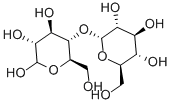 |
| CAS Number | 64044-51-5 |
| Molecular Formula | C12H24O12 |
| Molecular Weight | 360.31 g/mol |
| InChIKey | WSVLPVUVIUVCRA-KPKNDVKVSA-N |
| SMILES | Available on request where applicable |
| Appearance | White to off-white crystalline powder |
| Purity / Grade | By agreed specification and batch COA |
| Storage | Keep tightly closed in a cool, dry, well-ventilated place |
Lactose Monohydrate (CAS 64044-51-5) is a disaccharide sugar composed of galactose and glucose, with the formula C₁₂H₂₂O₁₁·H₂O (MW 360.31). It is a widely used pharmaceutical excipient for tablet and capsule manufacturing, serving as a filler-diluent that provides bulk, flow, and compressibility. Pharmaceutical-grade lactose is produced from bovine whey and is available in multiple functional grades optimized for different tableting processes.
TCS Industries Limited, a Hong Kong-based trading and sourcing company, supplies multiple particle-size grades of Lactose Monohydrate — sieved, milled, spray-dried and granulated — for direct compression, wet granulation and dry powder inhaler formulations.
> Applications
Direct compression and wet granulation for tablets
Spray-dried lactose (e.g., FlowLac, SuperTab) and granulated lactose grades provide the flowability and compactibility needed for high-speed tablet presses. Sieved and milled grades are used in wet granulation where the lactose dissolves during binder addition and recrystallizes on drying, contributing to granule strength. Typical tablet formulations contain 30–80% lactose by weight depending on API loading. Rowe et al. (Handbook of Pharmaceutical Excipients, 2012) remains the standard reference for grade selection.
Dry powder inhaler carrier particles
Coarse sieved lactose (63–90 µm or 90–150 µm fractions) serves as the carrier in capsule-based and reservoir DPI devices. Micronized API particles adhere to the lactose surface and detach upon inhalation. Surface roughness, fine particle content (<10 µm fines), and moisture content directly affect aerosolization performance and fine particle fraction (FPF). Inhalation-grade lactose must comply with Ph.Eur. specific monograph requirements for protein content and microbial limits.
Capsule filling and sachet formulations
Milled lactose grades with controlled particle size distribution (D50 typically 50–100 µm) are used as diluents in hard gelatin capsule fills. For powder-for-suspension and sachet products, granulated lactose provides improved wetting and dissolution. Lactose is compatible with most APIs but is contraindicated with compounds containing primary amines due to Maillard browning.
> Sourcing & Supply
TCS Industries Limited supports development, qualification and commercial purchasing discussions for Lactose Monohydrate –-– Classic Filler & Carrier for Solid Dosage Forms with buyers in Germany, France, Italy, Spain, the United Kingdom, the United States, Canada and Australia.
- Evaluation and development quantities: 5–25 kg packs for formulation screening, grade comparison, and incoming QC method validation. Multiple grades (sieved, milled, spray-dried, granulated) can be supplied for side-by-side evaluation.
- Pallet quantities and production campaigns: repeat supply is coordinated against packaging, lead time, annual demand and destination-market import requirements.
> Quality & Documentation
Key specification parameters include assay (≥99.0% C₁₂H₂₂O₁₁·H₂O), water content (4.5–5.5% for monohydrate), specific rotation, glucose, protein, sulfated ash, heavy metals (Pb ≤0.5 ppm), particle size distribution (grade-specific), flow properties (Carr index, Hausner ratio), and microbial limits. White crystalline powder or granular. Inhalation grades require additional tests (fines content, bacterial endotoxins). Meets USP-NF, Ph.Eur. (Lactosum monohydricum), and JP. COA and MSDS are standard.
> Packaging
Lactose Monohydrate is hygroscopic and should be stored in sealed containers in a dry environment. Standard packaging includes 25 kg multiply paper bags with PE liner, fibre drums for smaller lots, and palletized shrink-wrapped units for production campaigns. Inhalation-grade lactose is packed under controlled humidity conditions. Labels and documents are checked before dispatch.
> Pricing & MOQ
Pricing is quoted by specification, packaging and destination. Common commercial discussions use 25 kg bag/drum formats, pallet quantities and production-campaign planning; smaller samples may be reviewed for qualified formulation teams.
> Regulatory & Compounding Context
Lactose monohydrate is monographed in USP-NF, Ph.Eur. (Lactosum monohydricum), BP, JP, and FCC. Listed in the FDA IID for oral, inhalation, and other dosage forms. GRAS in the US. Approved as a food ingredient in the EU. Bovine origin requires BSE/TSE-free certification per EMA/EDQM guidelines. No special import permits.
> Alias Index
- Chemical name: 4-O-β-D-Galactopyranosyl-D-glucopyranose monohydrate
- CAS Number: 64044-51-5 (monohydrate); 63-42-3 (anhydrous)
- Formula: C₁₂H₂₂O₁₁·H₂O (MW 360.31)
- Pharmacopoeial name: Lactosum monohydricum (Ph.Eur.)
- Functional grades: Sieved, Spray-dried, Granulated, Anhydrous, Inhalation
- Brand equivalents: FlowLac, Tablettose, InhaLac, Pharmatose, SuperTab (various manufacturers)
- Commercial request terms: lactose monohydrate USP, spray-dried direct compression, inhalation grade lactose, DPI carrier, TCS Industries Limited
> FAQ
What lactose grade is needed for direct compression?
Spray-dried lactose (FlowLac/Tablettose equivalent) has engineered spherical agglomerates with controlled fines that provide both flow and compressibility for direct compression. Standard sieved lactose has good flow but poor compressibility for DC. Granulated lactose has intermediate properties. Specify “direct compression grade” at inquiry.
What documents are available for Lactose Monohydrate –-– Classic Filler & Carrier for Solid Dosage Forms orders?
COA and MSDS are standard for commercial discussions. COO, packing list, invoice and other import-support documents can be arranged according to order scope.
Do you supply Lactose Monohydrate –-– Classic Filler & Carrier for Solid Dosage Forms to Germany, France and Spain?
Yes. We support B2B buyers in Germany, France, Italy, Spain, the United Kingdom, the Netherlands, Poland and Switzerland, subject to route and document review.
Do you supply the United States, Canada and Australia?
Yes. We review the United States, Canada, Australia and New Zealand for project supply, import documents, packaging and logistics planning before quotation.
Is Lactose suitable for lactose-intolerant patients?
The amount of lactose in a tablet (typically 50–500 mg) is far below the threshold causing symptoms in most lactose-intolerant individuals (symptoms typically at 12–18 g). However, some patients may avoid lactose-containing products by preference. Alternative fillers include mannitol, microcrystalline cellulose, and dicalcium phosphate.
What is BSE/TSE-free certification?
Pharmaceutical lactose is derived from bovine whey (milk). EMA and EDQM require documentation that the source animals and manufacturing process comply with TSE (transmissible spongiform encephalopathy) guidelines. Milk is classified as a low-risk tissue. Suppliers provide BSE/TSE-free certificates as standard.
Can you arrange samples before commercial purchasing?
Samples or evaluation quantities may be reviewed for qualified buyers after target specification, application and destination-market requirements are clarified.
How is Lactose Monohydrate –-– Classic Filler & Carrier for Solid Dosage Forms packaged for export?
Packaging is confirmed by quantity and material properties. Typical options include foil bags, HDPE containers, fibre drums, 25 kg bags or palletized export packaging.
Can buyer-defined specifications be reviewed?
Yes. Send the specification, methods, impurity limits and required documents. TCS can review feasibility before confirming quotation and lead time.
What payment terms are normally used?
Standard payment is 100% T/T before dispatch unless a different arrangement has been approved for an established commercial account.
What lead time should buyers expect?
Lead time depends on stock, batch size, document scope and destination. Available stock can move faster; made-to-order or pallet programs require longer planning.
What is inhalation-grade Lactose?
Inhalation-grade lactose has controlled particle size distribution (63–90 µm carrier particles with defined fines content), low protein levels, controlled surface energy, and meets bacterial endotoxin limits. Standard oral-grade lactose is not suitable for DPI formulations. Specify inhalation grade and target DPI device type at inquiry.
Last reviewed: June 2026
Evaluation and research orders (≤10 kg) are shipped with COA, MSDS, and certificate of origin. Bulk commercial orders (>10 kg) qualify for volume pricing with a full technical documentation package available on request.
> Request a Quote
If your team already has a target application, estimated quantity, destination market, or documentation requirements, send those details so the commercial response can be prepared more efficiently.