
TCS Industries Limited (China-sourced API supplier) supplies Bimatoprost — API CAS 155206-00-1 for pharmaceutical B2B procurement — COA, MSDS, and technical documentation available on request.
> Overview
| Product Name | Bimatoprost |
|---|---|
| Structural Formula | 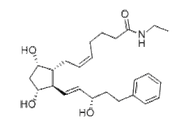 |
| CAS Number | 155206-00-1 |
| Molecular Formula | C25H37NO4 |
| Molecular Weight | 415.6 g/mol |
| InChIKey | AQOKCDNYWBIDND-FTOWTWDKSA-N |
| SMILES | Available on request where applicable |
| Appearance | White to off-white crystalline powder |
| Purity / Grade | By agreed specification and batch COA |
| Storage | Store at controlled room temperature |
Bimatoprost (CAS 155206-00-1) is a synthetic prostamide analog with the formula C₂₅H₃₇NO₄ (MW 415.57). It lowers intraocular pressure (IOP) by increasing aqueous humor outflow through both the trabecular meshwork and uveoscleral pathways. Bimatoprost is used for glaucoma, ocular hypertension, and as an eyelash growth enhancer (hypotrichosis).
TCS Industries Limited, a Hong Kong-based trading and sourcing company, supplies Bimatoprost API in pharmaceutical grade for global procurement programs.
> Applications
Glaucoma and ocular hypertension
Bimatoprost ophthalmic solution 0.01–0.03% is instilled once daily for open-angle glaucoma and ocular hypertension. It reduces IOP by 25–35% from baseline. Bimatoprost enhances outflow through both the uveoscleral and trabecular pathways, providing greater IOP reduction than timolol. Brubaker et al. (Ophthalmology, 2001, 108:302–307) demonstrated that bimatoprost achieved clinically superior IOP reduction compared to timolol 0.5% in patients with open-angle glaucoma.
Eyelash hypotrichosis
Bimatoprost 0.03% solution (Latisse) is FDA-approved for inadequate or insufficient eyelashes. Applied to the upper eyelid margin once daily using a sterile applicator, it increases lash length, thickness, and darkness through prolongation of the anagen (growth) phase of the eyelash hair cycle. This is a cosmetic/aesthetic indication with medical device-like application.
> Sourcing & Supply
TCS Industries Limited supports development, qualification and commercial purchasing discussions for Bimatoprost with buyers in Australia, New Zealand, Canada and South Korea.
- Evaluation and commercial quantities: 50 g samples for analytical qualification; 500 g and 1 kg for production. Pharmaceutical-grade crystalline powder. DMF reference letters available.
- Pallet quantities and production campaigns: repeat supply is coordinated against packaging, lead time, annual demand and destination-market import requirements.
> Quality & Documentation
Key specification parameters include assay (≥98.0%), related substances (15-epi-bimatoprost, bimatoprost acid), optical rotation, water content, residual solvents, heavy metals, and microbial limits. White to off-white crystalline powder. Soluble in ethanol and acetonitrile, slightly soluble in water. Identity by HPLC and IR. Meets in-house pharmaceutical specifications. COA, MSDS, and stability data are standard.
> Packaging
Bimatoprost is a white to off-white crystalline powder. Standard packaging includes sealed aluminium foil bags under nitrogen in fibre drums (50 g, 100 g, 500 g, or 1 kg). Store at 2–8 °C or controlled room temperature per manufacturer specification. Protect from light. Shelf life is typically 24–36 months. Labels and documents are checked before dispatch.
> Pricing & MOQ
Pricing is quoted by specification, packaging and destination. Common commercial discussions use 25 kg bag/drum formats, pallet quantities and production-campaign planning; smaller samples may be reviewed for qualified formulation teams.
> Regulatory & Compounding Context
Bimatoprost was FDA-approved in 2001 (Lumigan 0.03%) for glaucoma and 2008 (Latisse 0.03%) for eyelash growth. EMA-authorized. Bimatoprost 0.01% (Lumigan 0.01%) approved in 2010 with improved tolerability. Generic bimatoprost ophthalmic solutions available. DMF support available from qualified manufacturers.
> Alias Index
- INN: Bimatoprost
- CAS Number: 155206-00-1
- Formula: C₂₅H₃₇NO₄ (MW 415.57)
- Brand names: Lumigan (glaucoma), Latisse (eyelash growth)
- ATC code: S01EE03
- Chemical class: Prostamide analog
- Commercial request terms: bimatoprost API, Lumigan generic, prostaglandin analog glaucoma, eyelash growth API, TCS Industries Limited
> FAQ
How does Bimatoprost differ from Latanoprost?
Both are prostaglandin-type IOP-lowering agents, but bimatoprost is a prostamide (ethyl amide) while latanoprost is a prostaglandin F2α isopropyl ester (prodrug). Bimatoprost enhances outflow through both trabecular and uveoscleral pathways; latanoprost primarily through uveoscleral. Bimatoprost may achieve slightly greater IOP reduction in some patients.
What documents are available for Bimatoprost orders?
COA and MSDS are standard for commercial discussions. COO, packing list, invoice and other import-support documents can be arranged according to order scope.
Do you supply Bimatoprost to Australia and Canada?
Yes. We support B2B buyers in Australia, New Zealand, Canada and South Korea, subject to route and document review.
Do you supply New Zealand and South Korea?
Yes. We review Australia, New Zealand, Canada and South Korea for project supply, import documents, packaging and logistics planning before quotation.
Can Bimatoprost change iris colour?
Yes. Bimatoprost (and other prostaglandin analogs) can increase melanin content in iris melanocytes, causing irreversible brown pigmentation of light-coloured irides. This occurs in 1–10% of patients over months to years. Periorbital skin darkening and eyelash changes (length, thickness, number, colour) are also reported.
Is a DMF available?
Yes. TCS sources bimatoprost from manufacturers who maintain active Drug Master Files with the FDA and equivalent regulatory submissions with EMA. COA, stability data, and DMF reference letters are provided for generic ophthalmic formulation development and ANDA submissions.
Can you arrange samples before commercial purchasing?
Samples or evaluation quantities may be reviewed for qualified buyers after target specification, application and destination-market requirements are clarified.
How is Bimatoprost packaged for export?
Packaging is confirmed by quantity and material properties. Typical options include foil bags, HDPE containers, fibre drums, 25 kg bags or palletized export packaging.
Can buyer-defined specifications be reviewed?
Yes. Send the specification, methods, impurity limits and required documents. TCS can review feasibility before confirming quotation and lead time.
What payment terms are normally used?
Standard payment is 100% T/T before dispatch unless a different arrangement has been approved for an established commercial account.
What lead time should buyers expect?
Lead time depends on stock, batch size, document scope and destination. Available stock can move faster; made-to-order or pallet programs require longer planning.
What formulation challenges exist for ophthalmic use?
Bimatoprost ophthalmic solutions require preservative (benzalkonium chloride 0.005% or preservative-free unit-dose), precise pH control (6.8–7.8), osmolality adjustment, and sterile filtration. The 0.01% formulation uses higher BAK concentration (0.02%) to maintain bioavailability at the lower drug concentration.
Last reviewed: June 2026
Evaluation and research orders (≤10 kg) are shipped with COA, MSDS, and certificate of origin. Bulk commercial orders (>10 kg) qualify for volume pricing with a full technical documentation package available on request.
> Request a Quote
If your team already has a target application, estimated quantity, destination market, or documentation requirements, send those details so the commercial response can be prepared more efficiently.