
TCS Industries Limited (China-sourced API supplier) supplies Succinic Acid — Pharmaceutical Excipient CAS 110-15-6 for pharmaceutical B2B procurement — COA, MSDS, and technical documentation available on request.
> Overview
| Product Name | Succinic Acid –- Multifunctional Organic Acid & Intermediate |
|---|---|
| Structural Formula | 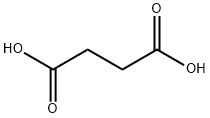 |
| CAS Number | 110-15-6 |
| Molecular Formula | C₄H₆O₄ |
| Molecular Weight | 118.09 g/mol |
| InChIKey | KDYFGRWQOYBRFD-UHFFFAOYSA-N |
| SMILES | Available on request where applicable |
| Appearance | White crystalline powder or granules |
| Purity / Grade | By agreed specification and batch COA |
| Storage | Keep tightly closed in a cool, dry, well-ventilated place |
Succinic Acid (CAS 110-15-6) is a dicarboxylic acid with the formula C₄H₆O₄ (MW 118.09). It is produced commercially by petrochemical hydrogenation of maleic anhydride or increasingly by fermentation of glucose using engineered microorganisms (bio-based succinic acid). Succinic acid is used as a food acidulant (E363), pharmaceutical excipient, and industrial chemical intermediate for synthesis of 1,4-butanediol, tetrahydrofuran, and biodegradable polyesters (PBS).
TCS Industries Limited, a Hong Kong-based trading and sourcing company, supplies Succinic Acid in food (FCC/E363), pharmaceutical, and industrial grades for global procurement programs.
> Applications
Food acidulant and flavor modifier
Succinic acid (E363) is used as an acidulant and flavor enhancer in beverages, seasonings, and food products. It has a mild, umami-like savory taste at low concentrations that enhances flavor perception in sauces, soups, and savory snacks. In Japanese cuisine, succinic acid occurs naturally in fermented products (sake, soy sauce) and contributes to the umami profile. Zeikus et al. (Appl Microbiol Biotechnol, 1999, 51:545–552) reviewed microbial production and food applications of succinic acid.
Chemical intermediate and bio-based platform
Succinic acid is a C4 platform chemical for synthesis of 1,4-butanediol, gamma-butyrolactone, tetrahydrofuran, N-methylpyrrolidone, and polybutylene succinate (PBS, a biodegradable polyester). Bio-based succinic acid from fermentation is a renewable alternative to petrochemical-derived material. It is also used as a pharmaceutical excipient and in cosmetic pH adjustment.
> Sourcing & Supply
TCS Industries Limited supports development, qualification and commercial purchasing discussions for Succinic Acid –- Multifunctional Organic Acid & Intermediate with buyers in Germany, France, Italy, Spain, the United Kingdom, the United States, Canada and Australia.
- Evaluation and commercial quantities: 25 kg bags for qualification; pallet and bulk for production. Petrochemical and bio-based (fermentation) sources in food (FCC/E363), pharma, and industrial grades available.
- Pallet quantities and production campaigns: repeat supply is coordinated against packaging, lead time, annual demand and destination-market import requirements.
> Quality & Documentation
Key specification parameters include assay (≥99.0% by titration), melting point (185–190 °C), maleic acid (≤0.1%), fumaric acid, loss on drying (≤0.5%), residue on ignition (≤0.1%), heavy metals (Pb ≤1 ppm), arsenic, and microbial limits (food grade). White crystalline powder or granules. Identity confirmed by melting point and IR spectrum. Bio-based certification available on request. COA and MSDS are standard.
> Packaging
Succinic acid is a white crystalline solid, stable and non-hygroscopic. Standard packaging includes 25 kg polypropylene woven bags with PE liner, palletized and shrink-wrapped. Store at room temperature in dry conditions. Shelf life is typically 36 months. Labels and documents are checked before dispatch.
> Pricing & MOQ
Pricing is quoted by specification, packaging and destination. Common commercial discussions use 25 kg bag/drum formats, pallet quantities and production-campaign planning; smaller samples may be reviewed for qualified formulation teams.
> Regulatory & Compounding Context
Succinic acid is approved as a food additive in the EU (E363, Regulation 1333/2008, max use levels by food category). GRAS in the US (21 CFR 184.1091). Monographed in FCC and JECFA. ADI: not specified (JECFA: ADI not limited). Ph.Eur. monograph available (Acidum succinicum). No special import permits for food/pharma grades.
> Alias Index
- IUPAC: Butanedioic acid
- CAS Number: 110-15-6
- Formula: C₄H₆O₄ (MW 118.09)
- EU food additive: E363
- Common names: Succinic acid, Amber acid, Butanedioic acid
- Bio-based CAS: Same CAS; specify bio-based (fermentation) or petrochemical source
- InChIKey: KDYFGRWQOYBRFD-UHFFFAOYSA-N
- Commercial request terms: succinic acid food grade, E363, bio-based succinic acid, C4 platform chemical, TCS Industries Limited
> FAQ
What is the difference between petrochemical and bio-based Succinic Acid?
Petrochemical succinic acid is produced by hydrogenation of maleic anhydride from n-butane oxidation. Bio-based succinic acid is produced by bacterial fermentation of glucose (e.g., Basfia succiniciproducens, engineered E. coli). The chemical product is identical (same CAS, same purity). Bio-based material can be certified by carbon-14 testing (ASTM D6866). Specify source preference at inquiry.
What documents are available for Succinic Acid –- Multifunctional Organic Acid & Intermediate orders?
COA and MSDS are standard for commercial discussions. COO, packing list, invoice and other import-support documents can be arranged according to order scope.
Do you supply Succinic Acid –- Multifunctional Organic Acid & Intermediate to Germany, France and Spain?
Yes. We support B2B buyers in Germany, France, Italy, Spain, the United Kingdom, the Netherlands, Poland and Switzerland, subject to route and document review.
Do you supply the United States, Canada and Australia?
Yes. We review the United States, Canada, Australia and New Zealand for project supply, import documents, packaging and logistics planning before quotation.
Is Succinic Acid used in biodegradable plastics?
Yes. Succinic acid is a monomer for polybutylene succinate (PBS), a biodegradable and compostable polyester. PBS is used in packaging, agricultural film, and disposable cutlery. Bio-based succinic acid is the preferred feedstock for bio-PBS to achieve fully renewable-sourced biodegradable plastic.
Does Succinic Acid have umami flavor?
At low concentrations (0.01–0.05%), succinic acid contributes a mild savory/umami taste perception. It occurs naturally in fermented foods (sake, soy sauce, cheese) and shellfish. In food applications, it is used as a flavor enhancer in seasonings, soups, sauces, and savory snacks alongside MSG or nucleotide enhancers.
Can you arrange samples before commercial purchasing?
Samples or evaluation quantities may be reviewed for qualified buyers after target specification, application and destination-market requirements are clarified.
How is Succinic Acid –- Multifunctional Organic Acid & Intermediate packaged for export?
Packaging is confirmed by quantity and material properties. Typical options include foil bags, HDPE containers, fibre drums, 25 kg bags or palletized export packaging.
Can buyer-defined specifications be reviewed?
Yes. Send the specification, methods, impurity limits and required documents. TCS can review feasibility before confirming quotation and lead time.
What payment terms are normally used?
Standard payment is 100% T/T before dispatch unless a different arrangement has been approved for an established commercial account.
What lead time should buyers expect?
Lead time depends on stock, batch size, document scope and destination. Available stock can move faster; made-to-order or pallet programs require longer planning.
What is the regulatory status in the EU?
Succinic acid is approved as food additive E363 in the EU under Regulation 1333/2008 with maximum use levels specified by food category. It is also monographed in Ph.Eur. as Acidum succinicum for pharmaceutical use. ADI is not specified (JECFA considers it safe without numerical ADI). No novel food authorization required.
Last reviewed: June 2026
Evaluation and research orders (≤10 kg) are shipped with COA, MSDS, and certificate of origin. Bulk commercial orders (>10 kg) qualify for volume pricing with a full technical documentation package available on request.
> Request a Quote
If your team already has a target application, estimated quantity, destination market, or documentation requirements, send those details so the commercial response can be prepared more efficiently.