
TCS Industries Limited (China-sourced API supplier) supplies Sorbitol — Pharmaceutical Excipient CAS 50-70-4 for pharmaceutical B2B procurement — COA, MSDS, and technical documentation available on request.
> Overview
| Product Name | Sorbitol |
|---|---|
| Structural Formula | 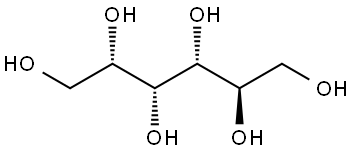 |
| CAS Number | 50-70-4 |
| Molecular Formula | C₆H₁₄O₆ |
| Molecular Weight | 182.17 g/mol |
| InChIKey | FBPFZTCFMRRESA-JGWLITMVSA-N |
| SMILES | Available on request where applicable |
| Appearance | White crystalline powder (or clear viscous liquid for 70% solution) |
| Purity / Grade | By agreed specification and batch COA |
| Storage | Keep tightly closed in a cool, dry, well-ventilated place |
Sorbitol (CAS 50-70-4) is a six-carbon sugar alcohol (polyol) with the formula C₆H₁₄O₆ (MW 182.17), produced by catalytic hydrogenation of glucose. It provides approximately 60% of sucrose sweetness with 2.6 kcal/g. Sorbitol is a versatile excipient and food ingredient used as a humectant, sweetener, plasticizer, and osmotic laxative in pharmaceutical, food, cosmetic, and industrial applications.
TCS Industries Limited, a Hong Kong-based trading and sourcing company, supplies Sorbitol in powder and 70% liquid forms across pharmaceutical, food, cosmetic, and technical grades.
> Applications
Pharmaceutical excipient and osmotic laxative
Sorbitol is used as a sweetening agent, humectant, and vehicle in oral liquids, syrups, and soft gelatin capsules. Sorbitol solution (70%) is a standard pharmaceutical vehicle listed in USP-NF and Ph.Eur. At higher doses (20–50 g), sorbitol acts as an osmotic laxative for bowel preparation. It is also used in toothpaste as a humectant (prevents paste from drying). Junginger et al. (Eur J Pharm Biopharm, 2002, 54:107–113) evaluated sorbitol as a pharmaceutical excipient for various dosage forms.
Food ingredient and sugar-free formulations
Sorbitol (E420) is used in sugar-free confectionery, chewing gum, baked goods, and diabetic products. It provides bulk, humectancy, and reduced sweetness. In frozen desserts, sorbitol depresses the freezing point and controls ice crystal size. Sorbitol is also used as an intermediate for vitamin C (ascorbic acid) production via the Reichstein process.
> Sourcing & Supply
TCS Industries Limited supports development, qualification and commercial purchasing discussions for Sorbitol with buyers in Germany, France, Italy, Spain, the United Kingdom, the United States, Canada and Australia.
- Evaluation and commercial quantities: 25 kg bags (powder) or 300 kg drums (70% liquid) for qualification; pallet, IBC, and bulk for production. Powder and 70% liquid in food and pharma grades available.
- Pallet quantities and production campaigns: repeat supply is coordinated against packaging, lead time, annual demand and destination-market import requirements.
> Quality & Documentation
Key specification parameters depend on form. Powder: assay (≥98.0% D-sorbitol by HPLC), mannitol, other polyols, reducing sugars, water content (≤1.0%), heavy metals (Pb ≤0.5 ppm), nickel, sulfated ash, pH, conductivity, and microbial limits. Liquid (70% solution): D-sorbitol content (≥69.0%), total solids, pH, reducing sugars, colour, heavy metals. Pharmaceutical grade must meet USP-NF or Ph.Eur. monograph. COA and MSDS are standard.
> Packaging
Sorbitol powder is mildly hygroscopic. Standard packaging includes 25 kg multiply paper bags with PE liner (powder) or 300 kg steel drums and IBC (70% liquid). Store at room temperature. Sorbitol solution should be protected from freezing. Shelf life is typically 24–36 months. Labels and documents are checked before dispatch.
> Pricing & MOQ
Pricing is quoted by specification, packaging and destination. Common commercial discussions use 25 kg bag/drum formats, pallet quantities and production-campaign planning; smaller samples may be reviewed for qualified formulation teams.
> Regulatory & Compounding Context
Sorbitol is approved as a food additive in the EU (E420, quantum satis for most categories). GRAS in the US. Monographed in USP-NF, Ph.Eur. (Sorbitolum), BP, and FCC. On the WHO Model List of Essential Medicines (as osmotic laxative). Listed in the FDA IID. ADI: not specified (JECFA). EU polyol laxative labeling requirement applies. No special import permits.
> Alias Index
- IUPAC: D-Glucitol
- CAS Number: 50-70-4
- Formula: C₆H₁₄O₆ (MW 182.17)
- EU food additive: E420
- Sweetness: ~60% of sucrose
- Caloric value: 2.6 kcal/g
- Pharmacopoeial name: Sorbitolum (Ph.Eur.)
- InChIKey: FBPFZTCFMRRESA-JGWLITMVSA-N
- Commercial request terms: sorbitol USP, E420, D-glucitol, sorbitol 70% liquid, pharmaceutical humectant, TCS Industries Limited
> FAQ
What forms of Sorbitol does TCS supply?
TCS sources crystalline powder (≥98% D-sorbitol) and 70% aqueous solution in pharmaceutical (USP-NF/Ph.Eur.) and food (FCC/E420) grades. Specify the physical form, grade, and intended application at inquiry.
What documents are available for Sorbitol orders?
COA and MSDS are standard for commercial discussions. COO, packing list, invoice and other import-support documents can be arranged according to order scope.
Do you supply Sorbitol to Germany, France and Spain?
Yes. We support B2B buyers in Germany, France, Italy, Spain, the United Kingdom, the Netherlands, Poland and Switzerland, subject to route and document review.
Do you supply the United States, Canada and Australia?
Yes. We review the United States, Canada, Australia and New Zealand for project supply, import documents, packaging and logistics planning before quotation.
Is Sorbitol suitable for diabetic products?
Sorbitol has a glycemic index of approximately 9 (vs. sucrose GI 65). It provides reduced caloric impact (2.6 kcal/g) and lower glycemic response. It is used in diabetic confectionery and sugar-free products. However, it can cause GI effects at doses above 20–30 g/day.
Is Sorbitol on the WHO Essential Medicines List?
Yes. Sorbitol (as an osmotic laxative preparation) is on the WHO Model List of Essential Medicines. This classification applies to pharmaceutical-grade material in specific dosage forms for bowel preparation and constipation management.
Can you arrange samples before commercial purchasing?
Samples or evaluation quantities may be reviewed for qualified buyers after target specification, application and destination-market requirements are clarified.
How is Sorbitol packaged for export?
Packaging is confirmed by quantity and material properties. Typical options include foil bags, HDPE containers, fibre drums, 25 kg bags or palletized export packaging.
Can buyer-defined specifications be reviewed?
Yes. Send the specification, methods, impurity limits and required documents. TCS can review feasibility before confirming quotation and lead time.
What payment terms are normally used?
Standard payment is 100% T/T before dispatch unless a different arrangement has been approved for an established commercial account.
What lead time should buyers expect?
Lead time depends on stock, batch size, document scope and destination. Available stock can move faster; made-to-order or pallet programs require longer planning.
What is the relationship between Sorbitol and Vitamin C?
Sorbitol is the starting material for vitamin C (ascorbic acid) production via the Reichstein process. D-sorbitol is oxidized by Acetobacter to L-sorbose, which is then converted to ascorbic acid through chemical steps. This is a major industrial use of sorbitol beyond food and pharma applications.
Last reviewed: June 2026
Evaluation and research orders (≤10 kg) are shipped with COA, MSDS, and certificate of origin. Bulk commercial orders (>10 kg) qualify for volume pricing with a full technical documentation package available on request.
> Request a Quote
If your team already has a target application, estimated quantity, destination market, or documentation requirements, send those details so the commercial response can be prepared more efficiently.