
TCS Industries Limited (China-sourced API supplier) supplies Polyethylene Glycol 1500 — Pharmaceutical Excipient CAS 25322-68-3 for pharmaceutical B2B procurement — COA, MSDS, and technical documentation available on request.
> Overview
| Product Name | Polyethylene Glycol 1500 |
|---|---|
| Structural Formula | 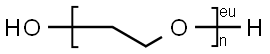 |
| CAS Number | 25322-68-3 |
| Molecular Formula | H(OC2H4)nOH |
| Molecular Weight | ~1,500 g/mol (n ≈ 34) |
| InChIKey | Not applicable (polydisperse polymer) |
| SMILES | Available on request where applicable |
| Appearance | White to off-white waxy solid |
| Purity / Grade | By agreed specification and batch COA |
| Storage | Keep tightly closed in a cool, dry, well-ventilated place |
PEG 1500 (CAS 25322-68-3) is a polyethylene glycol with an average molecular weight of approximately 1500 Da and the formula H(OCH₂CH₂)ₙOH (n ≈ 34). It is a white waxy solid at room temperature (melting point 44–48 °C). PEG 1500 is used as a suppository base component, ointment base, and fusion excipient in pharmaceutical formulations, occupying the transition zone between semisolid PEG 1000 and fully solid PEG 4000.
TCS Industries Limited, a Hong Kong-based trading and sourcing company, supplies PEG 1500 in pharmaceutical (USP-NF/Ph.Eur.) grade for global procurement programs.
> Applications
Suppository base and ointment formulation
PEG 1500 is used in suppository bases (blended with PEG 6000 or PEG 4000) and in PEG ointment bases where a firmer consistency than PEG 1000 is needed. Its intermediate melting point allows it to serve as either the soft component or the firming component depending on the blend ratio. Realdon et al. (Eur J Pharm Biopharm, 1997, 44:303–309) evaluated PEG 1500-based suppository formulations for rectal drug delivery optimization.
Hot-melt extrusion carrier
PEG 1500 is used as a carrier and plasticizer in hot-melt extrusion (HME) processes for amorphous solid dispersions. Its low melting point facilitates processing, and its water solubility aids drug dissolution from extruded dosage forms.
> Sourcing & Supply
TCS Industries Limited supports development, qualification and commercial purchasing discussions for Polyethylene Glycol 1500 with buyers in Germany, France, Italy, Spain, the United Kingdom, the United States, Canada and Australia.
- Evaluation and commercial quantities: 5 kg samples; 25 kg bags or cartons for production. Pharmaceutical (USP-NF/Ph.Eur.) grade available.
- Pallet quantities and production campaigns: repeat supply is coordinated against packaging, lead time, annual demand and destination-market import requirements.
> Quality & Documentation
Key specification parameters include average molecular weight (1300–1600), hydroxyl value (68–83 mg KOH/g), pH (4.5–7.5), water content (≤1.0%), residue on ignition (≤0.1%), ethylene glycol and diethylene glycol (≤0.25%), heavy metals (Pb ≤10 ppm), colour, and microbial limits. White waxy solid. Meets USP-NF (Polyethylene Glycol) and Ph.Eur. (Macrogolum 1500). COA and MSDS are standard.
> Packaging
PEG 1500 is a white waxy solid at room temperature. Standard packaging includes 25 kg bags or cardboard cartons with PE liner. Store at room temperature (15–25 °C) in dry conditions. Shelf life is typically 24 months. Labels and documents are checked before dispatch.
> Pricing & MOQ
Pricing is quoted by specification, packaging and destination. Common commercial discussions use 25 kg bag/drum formats, pallet quantities and production-campaign planning; smaller samples may be reviewed for qualified formulation teams.
> Regulatory & Compounding Context
PEG 1500 is monographed in USP-NF (Polyethylene Glycol) and Ph.Eur. (Macrogolum 1500). Listed in the FDA IID for oral, topical, and rectal dosage forms. No special import permits.
> Alias Index
- Chemical class: Polyethylene glycol
- CAS Number: 25322-68-3
- Average MW: ~1500 Da (n ≈ 34)
- Pharmacopoeial name: Macrogolum 1500 (Ph.Eur.)
- Physical state: Waxy solid (mp 44–48 °C)
- Commercial request terms: PEG 1500 USP, macrogol 1500, PEG suppository excipient, hot-melt extrusion carrier, TCS Industries Limited
> FAQ
When should I use PEG 1500 instead of PEG 1000?
PEG 1500 provides a firmer consistency (mp 44–48 °C vs. 35–40 °C for PEG 1000). Use PEG 1500 when a harder suppository or ointment base is needed, or in tropical climates where PEG 1000-based formulations may be too soft. PEG 1500 can serve as either the soft or hard component in PEG blends.
What documents are available for Polyethylene Glycol 1500 orders?
COA and MSDS are standard for commercial discussions. COO, packing list, invoice and other import-support documents can be arranged according to order scope.
Do you supply Polyethylene Glycol 1500 to Germany, France and Spain?
Yes. We support B2B buyers in Germany, France, Italy, Spain, the United Kingdom, the Netherlands, Poland and Switzerland, subject to route and document review.
Do you supply the United States, Canada and Australia?
Yes. We review the United States, Canada, Australia and New Zealand for project supply, import documents, packaging and logistics planning before quotation.
Is PEG 1500 suitable for hot-melt extrusion?
Yes. PEG 1500 melts at 44–48 °C, which is low enough for co-extrusion with thermally sensitive APIs. It provides a hydrophilic carrier matrix for amorphous solid dispersions. Processing temperatures are typically 50–80 °C when blended with polymers. Specify HME application at inquiry.
Are PEG 1000, 1500, and 4000 interchangeable?
No. They differ in melting point, viscosity, and formulation behavior. PEG suppository bases are formulated with specific MW blends to achieve target hardness and dissolution rate. Changing PEG grade requires reformulation and stability testing. Specify the exact PEG grade at inquiry.
Can you arrange samples before commercial purchasing?
Samples or evaluation quantities may be reviewed for qualified buyers after target specification, application and destination-market requirements are clarified.
How is Polyethylene Glycol 1500 packaged for export?
Packaging is confirmed by quantity and material properties. Typical options include foil bags, HDPE containers, fibre drums, 25 kg bags or palletized export packaging.
Can buyer-defined specifications be reviewed?
Yes. Send the specification, methods, impurity limits and required documents. TCS can review feasibility before confirming quotation and lead time.
What payment terms are normally used?
Standard payment is 100% T/T before dispatch unless a different arrangement has been approved for an established commercial account.
What lead time should buyers expect?
Lead time depends on stock, batch size, document scope and destination. Available stock can move faster; made-to-order or pallet programs require longer planning.
What is the EG/DEG testing requirement?
USP-NF requires combined ethylene glycol and diethylene glycol ≤0.25% in all pharmaceutical PEGs. This test is mandatory due to historical poisoning incidents from contaminated glycols. TCS supplies only pharmaceutical-grade PEGs with full COA including EG/DEG testing results.
Last reviewed: June 2026
Evaluation and research orders (≤10 kg) are shipped with COA, MSDS, and certificate of origin. Bulk commercial orders (>10 kg) qualify for volume pricing with a full technical documentation package available on request.
> Request a Quote
If your team already has a target application, estimated quantity, destination market, or documentation requirements, send those details so the commercial response can be prepared more efficiently.