
TCS Industries Limited (China-sourced API supplier) supplies Maltodextrin — Pharmaceutical Excipient CAS 9050-36-6 for pharmaceutical B2B procurement — COA, MSDS, and technical documentation available on request.
> Overview
| Product Name | Maltodextrin |
|---|---|
| Structural Formula | 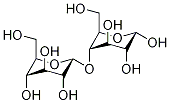 |
| CAS Number | 9050-36-6 |
| Molecular Formula | (C6H10O5)n·H2O |
| Molecular Weight | Grade-dependent (DE 10–20; typ. 1,800–3,600 g/mol) |
| InChIKey | Not applicable (polydisperse polymer) |
| SMILES | Available on request where applicable |
| Appearance | White to off-white free-flowing powder |
| Purity / Grade | By agreed specification and batch COA |
| Storage | Keep tightly closed in a cool, dry, well-ventilated place |
Maltodextrin (CAS 9050-36-6) is a polysaccharide produced by partial hydrolysis of starch (corn, potato, wheat, or tapioca). It consists of D-glucose units linked by α(1→4) glycosidic bonds with a dextrose equivalent (DE) of less than 20. Maltodextrin is a versatile food ingredient used as a filler, carrier, bulking agent, texture modifier, and spray-drying aid in processed foods, beverages, and pharmaceutical formulations.
TCS Industries Limited, a Hong Kong-based trading and sourcing company, supplies Maltodextrin in food and pharmaceutical grades from multiple starch sources for global procurement programs.
> Applications
Food ingredient and spray-drying carrier
Maltodextrin is used as a bulking agent, carrier for flavors and colors, fat replacer, and spray-drying encapsulation matrix. DE grade determines functional properties: low-DE maltodextrin (DE 5–10) provides good film-forming and encapsulation; mid-DE (DE 10–15) provides moderate sweetness and solubility; high-DE (DE 15–20) approaches glucose syrup characteristics. Chronakis et al. (Food Hydrocoll, 1998, 12:267–274) characterized the rheological and film-forming properties of maltodextrins across the DE range.
Pharmaceutical excipient and sports nutrition
Maltodextrin is monographed as a pharmaceutical excipient (USP-NF) and used as a diluent, binder, and coating agent in tablets and capsules. In sports nutrition, it provides rapidly digestible carbohydrate energy (4 kcal/g) with low osmolality for endurance energy gels and recovery drinks.
> Sourcing & Supply
TCS Industries Limited supports development, qualification and commercial purchasing discussions for Maltodextrin with buyers in Germany, France, Italy, Spain, the United Kingdom, the United States, Canada and Australia.
- Evaluation and commercial quantities: 25 kg bags for qualification; pallet and bulk for production. Multiple DE grades (5–10, 10–15, 15–20) from corn, potato, or tapioca starch sources available.
- Pallet quantities and production campaigns: repeat supply is coordinated against packaging, lead time, annual demand and destination-market import requirements.
> Quality & Documentation
Key specification parameters include DE (dextrose equivalent, specified grade), moisture (≤6.0%), sulfated ash, sulfur dioxide (≤20 ppm for food grade), heavy metals (Pb ≤0.5 ppm), pH, dextrose, colour, and microbial limits. Starch source (corn, potato, tapioca, wheat) must be declared for allergen labeling (wheat-derived contains gluten traces). Pharmaceutical grade must meet USP-NF monograph. COA and MSDS are standard.
> Packaging
Maltodextrin is a white, free-flowing powder. Hygroscopic at high humidity. Standard packaging includes 25 kg multiply paper bags with PE liner, palletized and shrink-wrapped. Store at room temperature in dry conditions (≤65% RH). Shelf life is typically 24 months. Labels and documents are checked before dispatch.
> Pricing & MOQ
Pricing is quoted by specification, packaging and destination. Common commercial discussions use 25 kg bag/drum formats, pallet quantities and production-campaign planning; smaller samples may be reviewed for qualified formulation teams.
> Regulatory & Compounding Context
Maltodextrin is GRAS in the US (21 CFR 184.1444). Approved as a food ingredient in the EU (no E-number — classified as a food ingredient, not an additive). Monographed in USP-NF. Listed in the FDA IID. Gluten-free status depends on starch source: corn, potato, and tapioca maltodextrin are gluten-free; wheat-derived requires allergen declaration. No special import permits.
> Alias Index
- Chemical class: Partially hydrolyzed starch (DE <20)
- CAS Number: 9050-36-6
- Composition: D-glucose polymers (α-1,4 linked, chain length 3–20 glucose units)
- Related products: Corn syrup solids (DE ≥20), Dextrose (DE 100)
- Starch sources: Corn (maize), potato, tapioca (cassava), wheat
- Commercial request terms: maltodextrin DE10-15, corn maltodextrin food grade, spray drying carrier, tapioca maltodextrin non-GMO, TCS Industries Limited
> FAQ
What does DE (dextrose equivalent) mean?
DE measures the degree of starch hydrolysis. DE 0 = intact starch, DE 100 = pure glucose. Maltodextrin is defined as DE <20. Lower DE provides better film-forming and encapsulation; higher DE provides more sweetness and solubility. Specify the required DE range at inquiry.
What documents are available for Maltodextrin orders?
COA and MSDS are standard for commercial discussions. COO, packing list, invoice and other import-support documents can be arranged according to order scope.
Do you supply Maltodextrin to Germany, France and Spain?
Yes. We support B2B buyers in Germany, France, Italy, Spain, the United Kingdom, the Netherlands, Poland and Switzerland, subject to route and document review.
Do you supply the United States, Canada and Australia?
Yes. We review the United States, Canada, Australia and New Zealand for project supply, import documents, packaging and logistics planning before quotation.
Is Maltodextrin gluten-free?
Maltodextrin from corn, potato, or tapioca starch is gluten-free. Wheat-derived maltodextrin may contain trace gluten and requires allergen declaration under EU Regulation 1169/2011 and US FALCPA. Specify the starch source and gluten-free requirement at inquiry.
Is Maltodextrin a sugar?
Maltodextrin is a polysaccharide (chains of 3–20 glucose units), not a simple sugar. However, it has a high glycemic index (GI ~85–105) similar to glucose. It is metabolized rapidly and provides 4 kcal/g. For labeling purposes, it is classified as a carbohydrate, not as “sugars.”
Can you arrange samples before commercial purchasing?
Samples or evaluation quantities may be reviewed for qualified buyers after target specification, application and destination-market requirements are clarified.
How is Maltodextrin packaged for export?
Packaging is confirmed by quantity and material properties. Typical options include foil bags, HDPE containers, fibre drums, 25 kg bags or palletized export packaging.
Can buyer-defined specifications be reviewed?
Yes. Send the specification, methods, impurity limits and required documents. TCS can review feasibility before confirming quotation and lead time.
What payment terms are normally used?
Standard payment is 100% T/T before dispatch unless a different arrangement has been approved for an established commercial account.
What lead time should buyers expect?
Lead time depends on stock, batch size, document scope and destination. Available stock can move faster; made-to-order or pallet programs require longer planning.
What starch sources does TCS supply?
TCS sources maltodextrin from corn (maize), potato, and tapioca (cassava) starch. Non-GMO and organic-certified options are available for tapioca and potato. Wheat-derived maltodextrin is available but must be labeled as an allergen. Specify starch source and DE grade at inquiry.
Last reviewed: June 2026
Evaluation and research orders (≤10 kg) are shipped with COA, MSDS, and certificate of origin. Bulk commercial orders (>10 kg) qualify for volume pricing with a full technical documentation package available on request.
> Request a Quote
If your team already has a target application, estimated quantity, destination market, or documentation requirements, send those details so the commercial response can be prepared more efficiently.