
TCS Industries Limited (China-sourced API supplier) supplies Ethyl Cellulose — Pharmaceutical Excipient CAS 9004-57-3 for pharmaceutical B2B procurement — COA, MSDS, and technical documentation available on request.
> Overview
| Product Name | Ethyl Cellulose |
|---|---|
| Structural Formula | 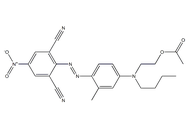 |
| CAS Number | 9004-57-3 |
| Molecular Formula | (C6H9.5O2.75)n (ethylated cellulose polymer) |
| Molecular Weight | Grade-dependent (typ. 50,000–200,000 g/mol) |
| InChIKey | Not applicable (polydisperse polymer) |
| SMILES | Available on request where applicable |
| Appearance | White to light tan free-flowing powder or granules |
| Purity / Grade | By agreed specification and batch COA |
| Storage | Keep tightly closed in a cool, dry, well-ventilated place |
Ethyl Cellulose (CAS 9004-57-3) is a non-ionic cellulose ether produced by ethylation of cellulose, with an ethoxyl content typically between 44–51% (corresponding to a degree of substitution of 2.2–2.6). It is an insoluble-in-water, film-forming polymer used as a sustained-release coating, tablet binder, granulation aid, and microencapsulation matrix in pharmaceutical dosage forms.
TCS Industries Limited, a Hong Kong-based trading and sourcing company, supplies Ethyl Cellulose in multiple viscosity grades for pharmaceutical and industrial procurement programs.
> Applications
Sustained-release coating and matrix former
Ethyl cellulose is the primary polymer for sustained-release film coatings on tablets, pellets, and granules. Applied as an organic solvent solution or aqueous dispersion (Surelease, Aquacoat ECD), it controls drug release rate through diffusion across the insoluble film. Film thickness, plasticizer type, and pore-forming agent (HPMC, PEG) modulate release kinetics. Ozturk et al. (J Control Release, 1990, 14:203–213) characterized drug release from ethyl cellulose-coated pellets as a function of coating level and plasticizer type.
Tablet binder and microencapsulation
Ethyl cellulose is used as a dry or wet binder in tablet granulation, providing hardness without affecting disintegration when used at low concentrations (2–5%). In microencapsulation, it serves as a wall material for taste-masking, moisture protection, and controlled release of APIs and flavors via solvent evaporation or coacervation techniques.
> Sourcing & Supply
TCS Industries Limited supports development, qualification and commercial purchasing discussions for Ethyl Cellulose with buyers in Germany, France, Italy, Spain, the United Kingdom, the United States, Canada and Australia.
- Evaluation and commercial quantities: 5 kg samples for formulation trials; 25 kg drums for production. Multiple viscosity grades (7, 10, 20, 45, 100 cP) available.
- Pallet quantities and production campaigns: repeat supply is coordinated against packaging, lead time, annual demand and destination-market import requirements.
> Quality & Documentation
Key specification parameters include ethoxyl content (44.0–51.0%), viscosity grade (7, 10, 20, 45, 100 cP in 5% toluene:ethanol 80:20 solution at 25 °C), loss on drying (≤3.0%), residue on ignition (≤0.4%), heavy metals (Pb ≤10 ppm), chloride, arsenic, and particle size. White to light tan powder or granular. Meets USP-NF and Ph.Eur. monographs. COA and MSDS are standard.
> Packaging
Ethyl cellulose is a white to light tan, free-flowing powder or granular material. Non-hygroscopic. Standard packaging includes 25 kg fibre drums with PE liner. Store at room temperature in dry conditions. Shelf life is typically 36 months. Labels and documents are checked before dispatch.
> Pricing & MOQ
Pricing is quoted by specification, packaging and destination. Common commercial discussions use 25 kg bag/drum formats, pallet quantities and production-campaign planning; smaller samples may be reviewed for qualified formulation teams.
> Regulatory & Compounding Context
Ethyl cellulose is monographed in USP-NF (Ethylcellulose), Ph.Eur. (Ethylcellulosum), and JP. Listed in the FDA IID for oral, topical, and ophthalmic dosage forms. Approved as a food additive in the EU (E462). GRAS for food-contact use. No ADI specified. No special import permits for pharmaceutical-grade material.
> Alias Index
- Chemical class: Cellulose ethyl ether
- CAS Number: 9004-57-3
- Ethoxyl content: 44.0–51.0%
- EU food additive: E462
- Pharmacopoeial name: Ethylcellulosum (Ph.Eur.)
- Brand equivalents: Ethocel (Dow/DuPont), Aqualon EC (Ashland)
- Commercial request terms: ethyl cellulose NF, EC 10 cP, sustained release coating polymer, Ethocel equivalent, TCS Industries Limited
> FAQ
What viscosity grade of Ethyl Cellulose should I use?
Lower viscosity grades (7, 10 cP) produce thinner, more flexible films suitable for coating. Higher viscosity grades (45, 100 cP) provide stronger, more rigid films and are used in matrix tablets. The 10 cP grade (Ethocel Standard 10 Premium equivalent) is commonly specified for film coating applications. Specify grade at inquiry.
What documents are available for Ethyl Cellulose orders?
COA and MSDS are standard for commercial discussions. COO, packing list, invoice and other import-support documents can be arranged according to order scope.
Do you supply Ethyl Cellulose to Germany, France and Spain?
Yes. We support B2B buyers in Germany, France, Italy, Spain, the United Kingdom, the Netherlands, Poland and Switzerland, subject to route and document review.
Do you supply the United States, Canada and Australia?
Yes. We review the United States, Canada, Australia and New Zealand for project supply, import documents, packaging and logistics planning before quotation.
Is Ethyl Cellulose soluble in water?
No. Ethyl cellulose is insoluble in water, which is why it functions as a sustained-release barrier. It dissolves in organic solvents (ethanol, dichloromethane, ethyl acetate, toluene-ethanol mixtures). Aqueous dispersions (Surelease, Aquacoat ECD) are latex systems, not true solutions.
What is the difference between Ethyl Cellulose and HPMC?
Ethyl cellulose (EC) is water-insoluble and used for sustained-release coatings. HPMC is water-soluble and used for immediate-release film coatings, matrix tablets, and as a binder. They are often used together: HPMC as a pore-former within EC sustained-release films to modulate drug release rate.
Can you arrange samples before commercial purchasing?
Samples or evaluation quantities may be reviewed for qualified buyers after target specification, application and destination-market requirements are clarified.
How is Ethyl Cellulose packaged for export?
Packaging is confirmed by quantity and material properties. Typical options include foil bags, HDPE containers, fibre drums, 25 kg bags or palletized export packaging.
Can buyer-defined specifications be reviewed?
Yes. Send the specification, methods, impurity limits and required documents. TCS can review feasibility before confirming quotation and lead time.
What payment terms are normally used?
Standard payment is 100% T/T before dispatch unless a different arrangement has been approved for an established commercial account.
What lead time should buyers expect?
Lead time depends on stock, batch size, document scope and destination. Available stock can move faster; made-to-order or pallet programs require longer planning.
Can Ethyl Cellulose be used for taste-masking?
Yes. EC coatings applied to drug particles or granules via fluidized bed coating mask the bitter taste of APIs by preventing contact with taste receptors in the mouth. The coating dissolves in the stomach (pH-independent) or the drug diffuses through at a controlled rate. This is a standard technique for pediatric and chewable formulations.
Last reviewed: June 2026
Evaluation and research orders (≤10 kg) are shipped with COA, MSDS, and certificate of origin. Bulk commercial orders (>10 kg) qualify for volume pricing with a full technical documentation package available on request.
> Request a Quote
If your team already has a target application, estimated quantity, destination market, or documentation requirements, send those details so the commercial response can be prepared more efficiently.