
TCS Industries Limited (China-sourced API supplier) supplies Colloidal Silicon Dioxide — Pharmaceutical Excipient CAS 7631-86-9 for pharmaceutical B2B procurement — COA, MSDS, and technical documentation available on request.
> Overview
| Product Name | Colloidal Silicon Dioxide |
|---|---|
| Structural Formula | 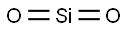 |
| CAS Number | 7631-86-9 |
| Molecular Formula | O2Si |
| Molecular Weight | 60.08 g/mol |
| InChIKey | VYPSYNLAJGMNEJ-UHFFFAOYSA-N |
| SMILES | Available on request where applicable |
| Appearance | White, fluffy, extremely light amorphous powder |
| Purity / Grade | By agreed specification and batch COA |
| Storage | Keep tightly closed in a cool, dry, well-ventilated place |
Colloidal Silicon Dioxide (CAS 7631-86-9, also known as fumed silica) has the formula SiO₂ (MW 60.08). It is an ultrafine, amorphous, white powder with extremely high specific surface area (200–400 m²/g) and particle size of 7–40 nm. Colloidal silicon dioxide is used as a glidant, anti-caking agent, adsorbent, and viscosity modifier in pharmaceutical, food, and cosmetic formulations.
TCS Industries Limited, a Hong Kong-based trading and sourcing company, supplies Colloidal Silicon Dioxide in pharmaceutical (NF/Ph.Eur.) and food grades for global procurement programs.
> Applications
Pharmaceutical glidant and flow aid
Colloidal silicon dioxide at 0.1–1.0% dramatically improves the flow properties of fine powders for tableting and capsule filling. It functions by coating powder particle surfaces, reducing inter-particle friction and cohesive forces. It is added during the final blending step (with or before the lubricant). Jonat et al. (Eur J Pharm Biopharm, 2004, 58:311–319) studied the mechanism of flow improvement by colloidal silica and the relationship between surface coverage and powder flowability.
Adsorbent and viscosity modifier
Colloidal silicon dioxide adsorbs liquids (oils, liquid APIs) onto its high surface area, converting them to free-flowing powders for tableting. In semisolid formulations (gels, ointments), it functions as a thixotropic thickener at 2–10%, forming a hydrogen-bonded network structure. In food applications (E551), it is an anti-caking agent in powdered foods.
> Sourcing & Supply
TCS Industries Limited supports development, qualification and commercial purchasing discussions for Colloidal Silicon Dioxide with buyers in Germany, France, Italy, Spain, the United Kingdom, the United States, Canada and Australia.
- Evaluation and commercial quantities: 5 kg bags for formulation trials; 10 kg or 15 kg bags for production. Multiple specific surface area grades (200, 300, 380 m²/g) available.
- Pallet quantities and production campaigns: repeat supply is coordinated against packaging, lead time, annual demand and destination-market import requirements.
> Quality & Documentation
Key specification parameters include SiO₂ content (≥99.0% on dried basis), loss on drying (≤2.5%), loss on ignition (≤2.0%), pH (3.5–5.5 in 4% dispersion), specific surface area (200 ± 25 m²/g for standard grade), heavy metals (Pb ≤10 ppm), arsenic, chloride, sulfate, and microbial limits. White, amorphous, ultrafine powder. Meets NF, Ph.Eur. (Silica colloidalis anhydrica), and JP. COA and MSDS are standard.
> Packaging
Colloidal silicon dioxide is an extremely fine, lightweight powder (bulk density ~50 g/L). Standard packaging includes 10 kg or 15 kg bags in outer cartons. Store at room temperature in dry conditions. Non-hygroscopic but absorbs volatile organic compounds. Shelf life is effectively indefinite. Labels and documents are checked before dispatch.
> Pricing & MOQ
Pricing is quoted by specification, packaging and destination. Common commercial discussions use 25 kg bag/drum formats, pallet quantities and production-campaign planning; smaller samples may be reviewed for qualified formulation teams.
> Regulatory & Compounding Context
Colloidal silicon dioxide is monographed in NF (Colloidal Silicon Dioxide), Ph.Eur. (Silica colloidalis anhydrica), and JP. Listed in the FDA IID for oral, topical, and other dosage forms. Approved as a food additive in the EU (E551). GRAS in the US (21 CFR 172.480). No special import permits.
> Alias Index
- Chemical name: Silicon dioxide (amorphous, fumed)
- CAS Number: 7631-86-9
- Formula: SiO₂ (MW 60.08)
- EU food additive: E551
- Pharmacopoeial name: Silica colloidalis anhydrica (Ph.Eur.)
- Brand equivalents: Aerosil (Evonik), Cab-O-Sil (Cabot), HDK (Wacker)
- Commercial request terms: colloidal silica NF, Aerosil 200 equivalent, fumed silica pharma grade, glidant E551, TCS Industries Limited
> FAQ
How much Colloidal Silicon Dioxide is needed as a glidant?
Typical concentration is 0.1–0.5% for glidant function. At 1.0%, maximum flow improvement is usually reached. Higher concentrations can decrease compactability. The optimal level depends on the cohesiveness of the powder blend. Optimize by measuring angle of repose or flow function at different concentrations.
What documents are available for Colloidal Silicon Dioxide orders?
COA and MSDS are standard for commercial discussions. COO, packing list, invoice and other import-support documents can be arranged according to order scope.
Do you supply Colloidal Silicon Dioxide to Germany, France and Spain?
Yes. We support B2B buyers in Germany, France, Italy, Spain, the United Kingdom, the Netherlands, Poland and Switzerland, subject to route and document review.
Do you supply the United States, Canada and Australia?
Yes. We review the United States, Canada, Australia and New Zealand for project supply, import documents, packaging and logistics planning before quotation.
Is Colloidal Silicon Dioxide the same as precipitated silica?
No. Colloidal (fumed) silica is produced by flame hydrolysis of silicon tetrachloride, yielding non-porous, ultrafine particles (7–40 nm, SSA 200–400 m²/g). Precipitated silica is produced by wet chemistry, yielding porous, larger particles with lower surface area. They have different NF monographs and different pharmaceutical functions.
Can Colloidal Silicon Dioxide absorb liquid APIs?
Yes. Colloidal silica can adsorb 1–3 times its weight of liquid, converting oily or liquid APIs to free-flowing powders suitable for tableting or capsule filling. This is used for drugs like vitamin E acetate (oil), essential oils, and liquid APIs. The adsorption capacity depends on the specific surface area grade.
Can you arrange samples before commercial purchasing?
Samples or evaluation quantities may be reviewed for qualified buyers after target specification, application and destination-market requirements are clarified.
How is Colloidal Silicon Dioxide packaged for export?
Packaging is confirmed by quantity and material properties. Typical options include foil bags, HDPE containers, fibre drums, 25 kg bags or palletized export packaging.
Can buyer-defined specifications be reviewed?
Yes. Send the specification, methods, impurity limits and required documents. TCS can review feasibility before confirming quotation and lead time.
What payment terms are normally used?
Standard payment is 100% T/T before dispatch unless a different arrangement has been approved for an established commercial account.
What lead time should buyers expect?
Lead time depends on stock, batch size, document scope and destination. Available stock can move faster; made-to-order or pallet programs require longer planning.
Is Colloidal Silicon Dioxide safe for oral use?
Yes. Amorphous silica (including fumed and precipitated forms) is GRAS and has no known systemic toxicity at pharmaceutical use levels. It passes through the GI tract unabsorbed. Crystalline silica (quartz) is a lung carcinogen, but colloidal silicon dioxide is strictly amorphous and must be clearly distinguished from crystalline forms.
Last reviewed: June 2026
> Request a Quote
If your team already has a target application, estimated quantity, destination market, or documentation requirements, send those details so the commercial response can be prepared more efficiently.