
TCS Industries Limited (China-sourced API supplier) supplies Citric Acid Monohydrate — Pharmaceutical Excipient CAS 5949-29-1 for pharmaceutical B2B procurement — COA, MSDS, and technical documentation available on request.
> Overview
| Product Name | Citric Acid Monohydrate |
|---|---|
| Structural Formula | 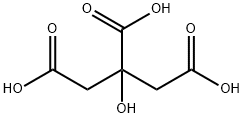 |
| CAS Number | 5949-29-1 |
| Molecular Formula | C6H10O8 |
| Molecular Weight | 210.14 g/mol |
| InChIKey | YASYEJJMZJALEJ-UHFFFAOYSA-N |
| SMILES | Available on request where applicable |
| Appearance | White or colourless crystalline powder or granules |
| Purity / Grade | By agreed specification and batch COA |
| Storage | Keep tightly closed in a cool, dry, well-ventilated place |
Citric Acid Monohydrate (CAS 5949-29-1) is the hydrated form of citric acid with the formula C₆H₈O₇·H₂O (MW 210.14), containing one molecule of crystal water per molecule of citric acid. It shares all functional properties of anhydrous citric acid — acidulant, chelator, preservative, pH buffer — and is the preferred form when crystal water is acceptable in the formulation and when lower dust generation during handling is desired.
TCS Industries Limited, a Hong Kong-based trading and sourcing company, supplies Citric Acid Monohydrate in food (FCC/E330) and pharmaceutical (USP/Ph.Eur.) grades for global procurement programs.
> Applications
Food acidulant and beverage ingredient
Citric acid monohydrate (E330) is used in beverages, confectionery, dairy, canned products, and seasonings. Its larger crystal size compared to the anhydrous form provides lower dustiness during handling in food production environments. In solution-based applications (beverages, syrups), the crystal water dissolves with the citric acid, making anhydrous and monohydrate interchangeable on a citric acid basis. Soccol et al. (Food Technol Biotechnol, 2006, 44:141–149) reviewed the production and applications of citric acid in food technology.
Pharmaceutical and cosmetic formulations
Citric acid monohydrate (USP/Ph.Eur.) is used in oral solutions, syrups, creams, and as a pH adjuster in cosmetic formulations. It is not suitable for effervescent tablets (crystal water triggers premature reaction with bicarbonate). In cosmetic formulations, it serves as an AHA (alpha-hydroxy acid) at low concentrations for mild exfoliation and pH adjustment.
> Sourcing & Supply
TCS Industries Limited supports development, qualification and commercial purchasing discussions for Citric Acid Monohydrate with buyers in Germany, France, Italy, Spain, the United Kingdom, the United States, Canada and Australia.
- Evaluation and commercial quantities: 25 kg bags for qualification; pallet and bulk (1000 kg FIBC) for production. Food and pharmaceutical grades available.
- Pallet quantities and production campaigns: repeat supply is coordinated against packaging, lead time, annual demand and destination-market import requirements.
> Quality & Documentation
Key specification parameters include assay (≥99.5% C₆H₈O₇ on dried basis), water content (monohydrate: 7.5–9.0%, corresponding to ~1 mol H₂O), sulfated ash (≤0.05%), sulfate, oxalate, readily carbonizable substances, heavy metals (Pb ≤0.5 ppm), arsenic, and microbial limits. White crystalline granules or powder. COA and MSDS are standard.
> Packaging
Citric acid monohydrate is a free-flowing white crystalline solid. It may lose crystal water under prolonged storage at temperatures above 36.6 °C (transition to anhydrous form). Standard packaging includes 25 kg polypropylene woven bags with PE liner, palletized. Store at room temperature below 30 °C in dry conditions. Shelf life is typically 36 months. Labels and documents are checked before dispatch.
> Pricing & MOQ
Pricing is quoted by specification, packaging and destination. Common commercial discussions use 25 kg bag/drum formats, pallet quantities and production-campaign planning; smaller samples may be reviewed for qualified formulation teams.
> Regulatory & Compounding Context
Citric acid monohydrate is approved under the same E-number as anhydrous citric acid (E330) in the EU. GRAS in the US. Monographed in USP (Citric Acid), Ph.Eur. (Acidum citricum monohydricum), BP, and FCC. No ADI specified (JECFA: ADI not limited). No special import permits.
> Alias Index
- IUPAC: 2-Hydroxypropane-1,2,3-tricarboxylic acid monohydrate
- CAS Number: 5949-29-1 (monohydrate); 77-92-9 (anhydrous)
- Formula: C₆H₈O₇·H₂O (MW 210.14)
- EU food additive: E330
- Water content: 7.5–9.0% (1 mol crystal water)
- Pharmacopoeial name: Acidum citricum monohydricum (Ph.Eur.)
- InChIKey: KRKNYBCHXYNGOX-UHFFFAOYSA-N (citric acid base)
- Commercial request terms: citric acid monohydrate food grade, E330, pharmaceutical grade citric acid hydrate, TCS Industries Limited
> FAQ
When should I use Monohydrate instead of Anhydrous?
Use monohydrate for solution-based applications (beverages, syrups, liquid pharmaceuticals) where crystal water has no impact. Use anhydrous for dry-mix applications (effervescent tablets, dry beverage mixes, seasoning blends) where moisture triggers unwanted reactions. Monohydrate has lower dustiness and may be easier to handle.
What documents are available for Citric Acid Monohydrate orders?
COA and MSDS are standard for commercial discussions. COO, packing list, invoice and other import-support documents can be arranged according to order scope.
Do you supply Citric Acid Monohydrate to Germany, France and Spain?
Yes. We support B2B buyers in Germany, France, Italy, Spain, the United Kingdom, the Netherlands, Poland and Switzerland, subject to route and document review.
Do you supply the United States, Canada and Australia?
Yes. We review the United States, Canada, Australia and New Zealand for project supply, import documents, packaging and logistics planning before quotation.
Does Monohydrate convert to Anhydrous during storage?
Citric acid monohydrate can lose its crystal water (effloresce) at temperatures above 36.6 °C or under very low humidity. Store below 30 °C in sealed packaging. For critical applications where hydration state matters, verify water content upon receipt and use within the recommended shelf life.
How do I convert between Anhydrous and Monohydrate quantities?
Monohydrate contains 91.4% citric acid and 8.6% water by mass (MW 210.14 vs. 192.12). To replace 100 g anhydrous citric acid with monohydrate, use 109.4 g monohydrate (100 × 210.14/192.12). Always calculate on a citric acid equivalent basis for accurate formulation.
Can you arrange samples before commercial purchasing?
Samples or evaluation quantities may be reviewed for qualified buyers after target specification, application and destination-market requirements are clarified.
How is Citric Acid Monohydrate packaged for export?
Packaging is confirmed by quantity and material properties. Typical options include foil bags, HDPE containers, fibre drums, 25 kg bags or palletized export packaging.
Can buyer-defined specifications be reviewed?
Yes. Send the specification, methods, impurity limits and required documents. TCS can review feasibility before confirming quotation and lead time.
What payment terms are normally used?
Standard payment is 100% T/T before dispatch unless a different arrangement has been approved for an established commercial account.
What lead time should buyers expect?
Lead time depends on stock, batch size, document scope and destination. Available stock can move faster; made-to-order or pallet programs require longer planning.
Is the E-number different for Monohydrate?
No. Both citric acid anhydrous and monohydrate are covered by E330 in the EU. The regulatory approvals, safety data, and ADI status are identical. The CAS numbers differ (anhydrous: 77-92-9, monohydrate: 5949-29-1) but the regulatory treatment is the same.
Last reviewed: June 2026
Evaluation and research orders (≤10 kg) are shipped with COA, MSDS, and certificate of origin. Bulk commercial orders (>10 kg) qualify for volume pricing with a full technical documentation package available on request.
> Request a Quote
If your team already has a target application, estimated quantity, destination market, or documentation requirements, send those details so the commercial response can be prepared more efficiently.