
TCS Industries Limited (China-sourced API supplier) supplies Chlorambucil — API CAS 305-03-3 for pharmaceutical B2B procurement — COA, MSDS, and technical documentation available on request.
> Overview
| Product Name | Chlorambucil |
|---|---|
| Structural Formula | 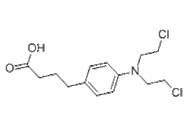 |
| CAS Number | 305-03-3 |
| Molecular Formula | C14H19Cl2NO2 |
| Molecular Weight | 304.2 g/mol |
| InChIKey | JCKYGMPEJWAADB-UHFFFAOYSA-N |
| SMILES | Available on request where applicable |
| Appearance | Off-white to pale yellow crystalline powder |
| Purity / Grade | By agreed specification and batch COA |
| Storage | Store at 2–8°C |
Chlorambucil (CAS 305-03-3) is a nitrogen mustard alkylating agent with the formula C₁₄H₁₉Cl₂NO₂ (MW 304.21). It is a slow-acting, orally administered bifunctional alkylator that cross-links DNA. Chlorambucil is used for chronic lymphocytic leukemia (CLL), Hodgkin and non-Hodgkin lymphoma, and Waldenstrom macroglobulinemia, and is on the WHO Model List of Essential Medicines.
TCS Industries Limited, a Hong Kong-based trading and sourcing company, supplies Chlorambucil API in pharmaceutical grade for global procurement programs.
> Applications
Chronic lymphocytic leukemia
Chlorambucil 0.1–0.2 mg/kg/day orally is used for CLL, particularly in elderly or frail patients who cannot tolerate intensive regimens. It is combined with obinutuzumab or rituximab in current treatment guidelines. Chlorambucil provides a well-tolerated oral option with predictable myelosuppression. Goede et al. (N Engl J Med, 2014, 370:1101–1110) demonstrated that obinutuzumab-chlorambucil significantly improved progression-free survival versus chlorambucil alone in previously untreated CLL patients with coexisting conditions.
Lymphoma and autoimmune diseases
Chlorambucil is used for indolent non-Hodgkin lymphoma, Waldenstrom macroglobulinemia, and off-label for autoimmune conditions (nephrotic syndrome, Behcet disease). Its oral administration, predictable pharmacokinetics, and mild toxicity profile make it suitable for outpatient and geriatric oncology settings.
> Sourcing & Supply
TCS Industries Limited supports development, qualification and commercial purchasing discussions for Chlorambucil with buyers in Australia, New Zealand, Canada and South Korea.
- Evaluation and commercial quantities: 50 g samples for analytical qualification; 500 g and 1 kg for production. Cytotoxic API — requires dedicated containment. DMF reference letters available.
- Pallet quantities and production campaigns: repeat supply is coordinated against packaging, lead time, annual demand and destination-market import requirements.
> Quality & Documentation
Key specification parameters include assay (≥98.0%), related substances (phenylacetic acid mustard, monohydroxychlorambucil), loss on drying, residual solvents, heavy metals, and microbial limits. Off-white to pale yellow crystalline powder. Slightly soluble in water, soluble in acetone and dilute alkali. Handle as cytotoxic material. Melting point 64–66 °C. Identity by HPLC and IR. Meets Ph.Eur. (Chlorambucilum) and BP. COA and MSDS are standard.
> Packaging
Chlorambucil is an off-white to pale yellow crystalline powder, cytotoxic. Standard packaging includes double-sealed foil bags in fibre drums (100 g, 500 g, or 1 kg). Store at 2–8 °C. Protect from light. Cytotoxic substance labeling applies. Shelf life is typically 24 months at 2–8 °C. Labels and documents are checked before dispatch.
> Pricing & MOQ
Pricing is quoted by specification, packaging and destination. Common commercial discussions use 25 kg bag/drum formats, pallet quantities and production-campaign planning; smaller samples may be reviewed for qualified formulation teams.
> Regulatory & Compounding Context
Chlorambucil is monographed in Ph.Eur. (Chlorambucilum) and BP. FDA-approved (Leukeran, 1957). On the WHO Model List of Essential Medicines. Generic chlorambucil tablets available. Cytotoxic API manufacturing required. DMF support available.
> Alias Index
- INN: Chlorambucil
- CAS Number: 305-03-3
- Formula: C₁₄H₁₉Cl₂NO₂ (MW 304.21)
- Brand name: Leukeran (Aspen)
- ATC code: L01AA02
- Chemical class: Nitrogen mustard alkylating agent
- Commercial request terms: chlorambucil API, Leukeran generic, CLL chemotherapy, nitrogen mustard API, TCS Industries Limited
> FAQ
Why is Chlorambucil still used when newer CLL drugs exist?
Chlorambucil remains relevant because it is oral, inexpensive, well-tolerated, and effective in combination with anti-CD20 antibodies (obinutuzumab, rituximab). It is the backbone of first-line CLL treatment for elderly/comorbid patients who cannot tolerate BTK inhibitors or venetoclax-based regimens. Cost and global availability favor chlorambucil in resource-limited settings.
What documents are available for Chlorambucil orders?
COA and MSDS are standard for commercial discussions. COO, packing list, invoice and other import-support documents can be arranged according to order scope.
Do you supply Chlorambucil to Australia and Canada?
Yes. We support B2B buyers in Australia, New Zealand, Canada and South Korea, subject to route and document review.
Do you supply New Zealand and South Korea?
Yes. We review Australia, New Zealand, Canada and South Korea for project supply, import documents, packaging and logistics planning before quotation.
How does Chlorambucil alkylate DNA?
Chlorambucil is a bifunctional nitrogen mustard. The two chloroethyl groups sequentially form aziridinium ion intermediates that alkylate the N-7 position of guanine in DNA. The two arms can cross-link DNA strands (interstrand cross-links), preventing strand separation during replication. Chlorambucil is slower-acting than mechlorethamine due to the phenylbutyric acid moiety.
What is the fertility impact?
Chlorambucil is gonadotoxic. Prolonged use causes azoospermia in males (often irreversible) and premature ovarian failure in females. Fertility preservation (sperm banking, oocyte cryopreservation) should be discussed before treatment. The risk is dose-cumulative and more severe with longer treatment duration.
Can you arrange samples before commercial purchasing?
Samples or evaluation quantities may be reviewed for qualified buyers after target specification, application and destination-market requirements are clarified.
How is Chlorambucil packaged for export?
Packaging is confirmed by quantity and material properties. Typical options include foil bags, HDPE containers, fibre drums, 25 kg bags or palletized export packaging.
Can buyer-defined specifications be reviewed?
Yes. Send the specification, methods, impurity limits and required documents. TCS can review feasibility before confirming quotation and lead time.
What payment terms are normally used?
Standard payment is 100% T/T before dispatch unless a different arrangement has been approved for an established commercial account.
What lead time should buyers expect?
Lead time depends on stock, batch size, document scope and destination. Available stock can move faster; made-to-order or pallet programs require longer planning.
Is a DMF available?
Yes. TCS sources chlorambucil from manufacturers who maintain active DMFs with the FDA and ASMF/CEP with EMA. Cytotoxic API production requires appropriate containment. COA, stability data, and DMF reference letters provided for generic dossier support.
Last reviewed: June 2026
Evaluation and research orders (≤10 kg) are shipped with COA, MSDS, and certificate of origin. Bulk commercial orders (>10 kg) qualify for volume pricing with a full technical documentation package available on request.
> Request a Quote
If your team already has a target application, estimated quantity, destination market, or documentation requirements, send those details so the commercial response can be prepared more efficiently.