
TCS Industries Limited (China-sourced API supplier) supplies Procarbazine HCl — API CAS 366-70-1 for pharmaceutical B2B procurement — COA, MSDS, and technical documentation available on request.
> Overview
| Product Name | Procarbazine HCl |
|---|---|
| Structural Formula | 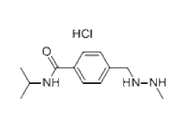 |
| CAS Number | 366-70-1 |
| Molecular Formula | C12H20ClN3O |
| Molecular Weight | 257.76 g/mol |
| InChIKey | DERJYEZSLHIUKF-UHFFFAOYSA-N |
| SMILES | Available on request where applicable |
| Appearance | White to yellowish crystalline powder |
| Purity / Grade | By agreed specification and batch COA |
| Storage | Store at controlled room temperature, protect from light and moisture |
Procarbazine Hydrochloride (CAS 366-70-1) is a methylhydrazine derivative alkylating agent with the formula C₁₂H₁₉N₃O·HCl (MW 257.76). It requires metabolic activation to generate alkylating species that methylate DNA. Procarbazine is used in combination chemotherapy for Hodgkin lymphoma and brain tumors and is on the WHO Model List of Essential Medicines.
TCS Industries Limited, a Hong Kong-based trading and sourcing company, supplies Procarbazine HCl API in pharmaceutical grade for global procurement programs.
> Applications
Hodgkin lymphoma combination chemotherapy
Procarbazine is a key component of the MOPP regimen (mechlorethamine, vincristine, procarbazine, prednisone) and its variants (COPP, BEACOPP) for Hodgkin lymphoma. It is also used in the PCV regimen (procarbazine, lomustine, vincristine) for brain tumors including oligodendroglioma and low-grade glioma. Oral dose is typically 100 mg/m²/day for 14 days in 28-day cycles. Diehl et al. (N Engl J Med, 2003, 348:2386–2395) demonstrated the superiority of escalated BEACOPP (containing procarbazine) over COPP-ABVD in advanced Hodgkin lymphoma with higher cure rates.
Brain tumor therapy
Procarbazine crosses the blood-brain barrier due to its lipophilic methylhydrazine structure. The PCV regimen is used as adjuvant chemotherapy for 1p/19q co-deleted oligodendroglioma and in combination with temozolomide-radiation for selected glioma patients.
> Sourcing & Supply
TCS Industries Limited supports development, qualification and commercial purchasing discussions for Procarbazine HCl with buyers in Australia, New Zealand, Canada and South Korea.
- Evaluation and commercial quantities: 50 g samples for analytical qualification; 500 g and 1 kg for production. Cytotoxic API — requires dedicated handling. DMF reference letters available.
- Pallet quantities and production campaigns: repeat supply is coordinated against packaging, lead time, annual demand and destination-market import requirements.
> Quality & Documentation
Key specification parameters include assay (≥98.0%), related substances, loss on drying, residue on ignition, residual solvents, heavy metals, and microbial limits. White to yellowish crystalline powder. Soluble in water. Handle as cytotoxic material. Identity by HPLC and IR. Meets USP (Procarbazine Hydrochloride) and in-house pharmaceutical specifications. COA and MSDS are standard.
> Packaging
Procarbazine HCl is a white to yellowish crystalline powder, cytotoxic. Soluble in water. Standard packaging includes double-sealed foil bags in fibre drums (100 g, 500 g, or 1 kg). Store at controlled room temperature (15–25 °C). Protect from light and moisture. Cytotoxic handling and labeling apply. Shelf life is typically 24 months. Labels and documents are checked before dispatch.
> Pricing & MOQ
Pricing is quoted by specification, packaging and destination. Common commercial discussions use 25 kg bag/drum formats, pallet quantities and production-campaign planning; smaller samples may be reviewed for qualified formulation teams.
> Regulatory & Compounding Context
Procarbazine HCl is monographed in USP. FDA-approved (Matulane, 1969) for Hodgkin lymphoma. On the WHO Model List of Essential Medicines. Generic procarbazine capsules available in limited markets. Manufacturing requires cytotoxic API handling. DMF support available.
> Alias Index
- INN: Procarbazine
- CAS Number: 366-70-1 (HCl); 671-16-9 (free base)
- Formula: C₁₂H₁₉N₃O·HCl (MW 257.76)
- Brand name: Matulane (Sigma-Tau)
- ATC code: L01XB01
- Regimen use: MOPP, BEACOPP (Hodgkin); PCV (brain tumors)
- Commercial request terms: procarbazine HCl API, Matulane generic, MOPP regimen API, PCV chemotherapy, TCS Industries Limited
> FAQ
Why is Procarbazine a monoamine oxidase inhibitor?
Procarbazine has weak MAO-inhibitory activity. Patients must avoid tyramine-rich foods (aged cheese, red wine, fermented foods) during treatment to prevent hypertensive crisis. This dietary restriction is clinically significant and must be communicated to patients. The MAO inhibition is a secondary pharmacological effect unrelated to its antitumor mechanism.
What documents are available for Procarbazine HCl orders?
COA and MSDS are standard for commercial discussions. COO, packing list, invoice and other import-support documents can be arranged according to order scope.
Do you supply Procarbazine HCl to Australia and Canada?
Yes. We support B2B buyers in Australia, New Zealand, Canada and South Korea, subject to route and document review.
Do you supply New Zealand and South Korea?
Yes. We review Australia, New Zealand, Canada and South Korea for project supply, import documents, packaging and logistics planning before quotation.
What is the mechanism of DNA alkylation?
Procarbazine undergoes hepatic CYP450-mediated oxidation to generate methyldiazonium and methyl free radical species that methylate DNA at N-7 and O-6 guanine positions. This metabolic activation pathway distinguishes procarbazine from direct-acting alkylators. The metabolic requirement means it has no direct in-vitro cytotoxic activity.
Is Procarbazine still used in current protocols?
Yes. Procarbazine remains in escalated BEACOPP for advanced Hodgkin lymphoma and in the PCV regimen for 1p/19q co-deleted oligodendroglioma. While newer regimens (ABVD, BV-AVD) have reduced its use in some Hodgkin protocols, it remains essential where escalated BEACOPP is preferred for high-risk disease.
Can you arrange samples before commercial purchasing?
Samples or evaluation quantities may be reviewed for qualified buyers after target specification, application and destination-market requirements are clarified.
How is Procarbazine HCl packaged for export?
Packaging is confirmed by quantity and material properties. Typical options include foil bags, HDPE containers, fibre drums, 25 kg bags or palletized export packaging.
Can buyer-defined specifications be reviewed?
Yes. Send the specification, methods, impurity limits and required documents. TCS can review feasibility before confirming quotation and lead time.
What payment terms are normally used?
Standard payment is 100% T/T before dispatch unless a different arrangement has been approved for an established commercial account.
What lead time should buyers expect?
Lead time depends on stock, batch size, document scope and destination. Available stock can move faster; made-to-order or pallet programs require longer planning.
What are the fertility risks?
Procarbazine is highly gonadotoxic, especially in males. It causes permanent azoospermia in most men treated with MOPP or BEACOPP regimens. Sperm banking before treatment is recommended. Female fertility impact is dose- and age-dependent. This gonadotoxicity is one reason ABVD (which lacks procarbazine) is preferred when cure rates are equivalent.
Last reviewed: June 2026
Evaluation and research orders (≤10 kg) are shipped with COA, MSDS, and certificate of origin. Bulk commercial orders (>10 kg) qualify for volume pricing with a full technical documentation package available on request.
> Request a Quote
If your team already has a target application, estimated quantity, destination market, or documentation requirements, send those details so the commercial response can be prepared more efficiently.