
TCS Industries Limited (China-sourced API supplier) supplies Sodium Citrate — Pharmaceutical Excipient CAS 6132-04-3 for pharmaceutical B2B procurement — COA, MSDS, and technical documentation available on request.
> Overview
| Product Name | Sodium Citrate |
|---|---|
| Structural Formula | 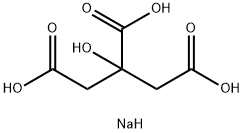 |
| CAS Number | 6132-04-3 |
| Molecular Formula | C6H9Na3O9 |
| Molecular Weight | 294.10 g/mol |
| InChIKey | NLJMYIDDQXHKNR-UHFFFAOYSA-K |
| SMILES | Available on request where applicable |
| Appearance | White granular crystals or crystalline powder |
| Purity / Grade | By agreed specification and batch COA |
| Storage | Keep tightly closed in a cool, dry, well-ventilated place |
Sodium Citrate (CAS 6132-04-3, trisodium citrate dihydrate) has the formula Na₃C₆H₅O₇·2H₂O (MW 294.10). It is the trisodium salt of citric acid, a white crystalline powder that is freely soluble in water. Sodium citrate is used as a buffer, anticoagulant, emulsifier, and sequestrant in pharmaceutical, food, and clinical laboratory applications.
TCS Industries Limited, a Hong Kong-based trading and sourcing company, supplies Sodium Citrate in pharmaceutical (USP/Ph.Eur.) and food (FCC/E331) grades for global procurement programs.
> Applications
Pharmaceutical buffer and anticoagulant
Sodium citrate is used as a buffering agent in oral solutions, syrups, and parenteral formulations (citrate-phosphate buffer systems). As an anticoagulant, it chelates calcium ions (essential for coagulation cascade), making it the standard anticoagulant in blood collection tubes (blue-top, 3.2% sodium citrate). Chuang et al. (Transfusion, 2004, 44:560–571) reviewed citrate anticoagulation mechanisms and its clinical applications in blood banking and apheresis procedures.
Food emulsifier and flavor modifier
Sodium citrate (E331(iii)) is used in food as an emulsifying salt (processed cheese), acidity regulator, sequestrant (chelating metal ions that promote oxidation), and flavor modifier (reducing perceived acidity in beverages). It is widely used in sports and rehydration drinks as an electrolyte component.
> Sourcing & Supply
TCS Industries Limited supports development, qualification and commercial purchasing discussions for Sodium Citrate with buyers in Germany, France, Italy, Spain, the United Kingdom, the United States, Canada and Australia.
- Evaluation and commercial quantities: 25 kg bags for qualification; pallet and bulk for production. Dihydrate and anhydrous forms in pharmaceutical (USP/Ph.Eur.) and food (FCC/E331) grades available.
- Pallet quantities and production campaigns: repeat supply is coordinated against packaging, lead time, annual demand and destination-market import requirements.
> Quality & Documentation
Key specification parameters include assay (≥99.0% Na₃C₆H₅O₇·2H₂O), water content (dihydrate: 10.0–13.0%), pH (7.5–9.0 in 5% solution), chloride, sulfate, oxalate, heavy metals (Pb ≤5 ppm), arsenic, calcium, iron, tartrate, and microbial limits. White crystalline powder or granular. Identity by citrate and sodium tests. Meets USP, Ph.Eur. (Natrii citras), and FCC. COA and MSDS are standard.
> Packaging
Sodium citrate dihydrate is a white, free-flowing crystalline powder. Non-hygroscopic under normal conditions. May effloresce in very dry conditions (loss of crystal water). Standard packaging includes 25 kg polypropylene bags with PE liner, palletized. Store at room temperature below 30 °C. Shelf life is typically 36 months. Labels and documents are checked before dispatch.
> Pricing & MOQ
Pricing is quoted by specification, packaging and destination. Common commercial discussions use 25 kg bag/drum formats, pallet quantities and production-campaign planning; smaller samples may be reviewed for qualified formulation teams.
> Regulatory & Compounding Context
Sodium citrate is monographed in USP, Ph.Eur. (Natrii citras), BP, JP, and FCC. Approved as a food additive in the EU (E331(iii)). GRAS in the US (21 CFR 182.1751). Listed in the FDA IID for oral, parenteral, and other dosage forms. On the WHO Model List of Essential Medicines (anticoagulant, as part of citrate-phosphate-dextrose blood bag solution). No special import permits.
> Alias Index
- IUPAC: Trisodium 2-hydroxypropane-1,2,3-tricarboxylate dihydrate
- CAS Number: 6132-04-3 (dihydrate); 68-04-2 (anhydrous)
- Formula: Na₃C₆H₅O₇·2H₂O (MW 294.10)
- EU food additive: E331(iii)
- Pharmacopoeial name: Natrii citras (Ph.Eur.)
- Related salts: Monosodium citrate E331(i), Disodium citrate E331(ii)
- InChIKey: HRXKRNGNAMMEHJ-UHFFFAOYSA-K
- Commercial request terms: sodium citrate dihydrate USP, trisodium citrate E331, anticoagulant citrate, buffer salt pharma, TCS Industries Limited
> FAQ
Why is Sodium Citrate used as an anticoagulant?
Sodium citrate chelates calcium ions (Ca²⁺), which are required cofactors in multiple steps of the coagulation cascade (Factors VII, IX, X, prothrombin). By removing available calcium, citrate prevents blood clotting. This is reversible — adding calcium chloride restores coagulation. This is why citrate is the standard anticoagulant for blood collection and storage.
What documents are available for Sodium Citrate orders?
COA and MSDS are standard for commercial discussions. COO, packing list, invoice and other import-support documents can be arranged according to order scope.
Do you supply Sodium Citrate to Germany, France and Spain?
Yes. We support B2B buyers in Germany, France, Italy, Spain, the United Kingdom, the Netherlands, Poland and Switzerland, subject to route and document review.
Do you supply the United States, Canada and Australia?
Yes. We review the United States, Canada, Australia and New Zealand for project supply, import documents, packaging and logistics planning before quotation.
What is the difference between Sodium Citrate and Citric Acid?
Citric acid (CAS 77-92-9) is the free acid form (pH ~2.2 in 1% solution). Sodium citrate (CAS 6132-04-3) is the trisodium salt (pH ~8.0 in 1% solution). Together they form a citrate buffer system (pH 3.0–6.5). Citric acid provides acidity; sodium citrate provides buffering and alkalinity. They are complementary excipients.
Is Sodium Citrate used in processed cheese?
Yes. Sodium citrate is an emulsifying salt used in processed cheese manufacturing. It chelates calcium from casein, allowing the protein to emulsify fat during heating. This produces the smooth, uniform texture of processed cheese. Typical concentration is 2–3% by weight.
Can you arrange samples before commercial purchasing?
Samples or evaluation quantities may be reviewed for qualified buyers after target specification, application and destination-market requirements are clarified.
How is Sodium Citrate packaged for export?
Packaging is confirmed by quantity and material properties. Typical options include foil bags, HDPE containers, fibre drums, 25 kg bags or palletized export packaging.
Can buyer-defined specifications be reviewed?
Yes. Send the specification, methods, impurity limits and required documents. TCS can review feasibility before confirming quotation and lead time.
What payment terms are normally used?
Standard payment is 100% T/T before dispatch unless a different arrangement has been approved for an established commercial account.
What lead time should buyers expect?
Lead time depends on stock, batch size, document scope and destination. Available stock can move faster; made-to-order or pallet programs require longer planning.
What is the Dihydrate vs. Anhydrous form?
Dihydrate (CAS 6132-04-3, MW 294.10) contains two molecules of crystal water. Anhydrous (CAS 68-04-2, MW 258.07) is water-free. Dihydrate is more commonly used in pharmaceutical and food applications. For dry formulations where moisture is critical, specify anhydrous form. Both have the same citrate ion content on a dry basis.
Last reviewed: June 2026
Evaluation and research orders (≤10 kg) are shipped with COA, MSDS, and certificate of origin. Bulk commercial orders (>10 kg) qualify for volume pricing with a full technical documentation package available on request.
> Request a Quote
If your team already has a target application, estimated quantity, destination market, or documentation requirements, send those details so the commercial response can be prepared more efficiently.