
TCS Industries Limited (China-sourced API supplier) supplies Polyethylene Glycol 6000 — Pharmaceutical Excipient CAS 25322-68-3 for pharmaceutical B2B procurement — COA, MSDS, and technical documentation available on request.
> Overview
| Product Name | Polyethylene Glycol 6000 |
|---|---|
| Structural Formula | 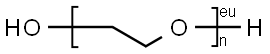 |
| CAS Number | 25322-68-3 |
| Molecular Formula | H(OC2H4)nOH |
| Molecular Weight | ~6,000 g/mol (n ≈ 136) |
| InChIKey | Not applicable (polydisperse polymer) |
| SMILES | Available on request where applicable |
| Appearance | White powder or flakes |
| Purity / Grade | By agreed specification and batch COA |
| Storage | Keep tightly closed in a cool, dry, well-ventilated place |
PEG 6000 (CAS 25322-68-3) is a polyethylene glycol with an average molecular weight of approximately 6000 Da and the formula H(OCH₂CH₂)ₙOH (n ≈ 136). It is a white, free-flowing waxy solid (melting point 55–63 °C) supplied as flakes, powder, or pastilles. PEG 6000 is the firmest of the commonly used pharmaceutical PEG grades, used as a suppository base hardener, tablet coating plasticizer, solid dispersion carrier, and melt granulation binder.
TCS Industries Limited, a Hong Kong-based trading and sourcing company, supplies PEG 6000 in pharmaceutical (USP-NF/Ph.Eur.) grade for global procurement programs.
> Applications
Solid dispersion carrier for poorly soluble drugs
PEG 6000 is used as a carrier in solid dispersions prepared by fusion or solvent evaporation methods. The drug is molecularly dispersed in the PEG matrix, increasing dissolution rate and bioavailability. PEG 6000 has sufficient MW to maintain a solid matrix at room temperature while providing rapid dissolution. Leuner et al. (Eur J Pharm Biopharm, 2000, 50:47–60) reviewed solid dispersions with PEG carriers for improving the oral bioavailability of poorly water-soluble drugs.
Suppository base and tablet plasticizer
PEG 6000 is the high-MW component in PEG suppository bases, providing firmness and structural integrity. In tablet coating, it functions as a plasticizer similar to PEG 4000. It is also used as a melt granulation binder where tablets are produced without water or organic solvents.
> Sourcing & Supply
TCS Industries Limited supports development, qualification and commercial purchasing discussions for Polyethylene Glycol 6000 with buyers in Germany, France, Italy, Spain, the United Kingdom, the United States, Canada and Australia.
- Evaluation and commercial quantities: 5 kg samples; 25 kg bags for production. Pharmaceutical (USP-NF/Ph.Eur.) grade in flakes, powder, or pastille form available.
- Pallet quantities and production campaigns: repeat supply is coordinated against packaging, lead time, annual demand and destination-market import requirements.
> Quality & Documentation
Key specification parameters include average molecular weight (5600–7000), hydroxyl value (16–22 mg KOH/g), pH (4.5–7.5), water content (≤1.0%), residue on ignition (≤0.1%), ethylene glycol and diethylene glycol (≤0.25%), heavy metals (Pb ≤10 ppm), colour, viscosity, and microbial limits. White waxy solid. Meets USP-NF (Polyethylene Glycol) and Ph.Eur. (Macrogolum 6000). COA and MSDS are standard.
> Packaging
PEG 6000 is a white, free-flowing waxy solid supplied as flakes or powder. Non-hygroscopic. Standard packaging includes 25 kg multiply paper bags with PE liner, palletized. Store at room temperature in dry conditions. Shelf life is typically 24 months. Labels and documents are checked before dispatch.
> Pricing & MOQ
Pricing is quoted by specification, packaging and destination. Common commercial discussions use 25 kg bag/drum formats, pallet quantities and production-campaign planning; smaller samples may be reviewed for qualified formulation teams.
> Regulatory & Compounding Context
PEG 6000 is monographed in USP-NF (Polyethylene Glycol) and Ph.Eur. (Macrogolum 6000). Listed in the FDA IID for oral, topical, and rectal dosage forms. Approved as an indirect food additive (food-contact materials). No special import permits.
> Alias Index
- Chemical class: Polyethylene glycol
- CAS Number: 25322-68-3
- Average MW: ~6000 Da (n ≈ 136)
- Pharmacopoeial name: Macrogolum 6000 (Ph.Eur.)
- Physical state: Waxy solid (mp 55–63 °C)
- Brand equivalents: Carbowax 6000, Pluriol E 6000
- Commercial request terms: PEG 6000 USP, macrogol 6000, solid dispersion carrier, melt granulation binder, TCS Industries Limited
> FAQ
Why is PEG 6000 used for solid dispersions?
PEG 6000 melts at 55–63 °C, which is low enough to avoid thermal degradation of most APIs. It dissolves rapidly in water, releasing the molecularly dispersed drug at an enhanced dissolution rate. The solid matrix is stable at room temperature, preventing recrystallization of the API during storage. These properties make it a standard carrier for fusion-based solid dispersions.
What documents are available for Polyethylene Glycol 6000 orders?
COA and MSDS are standard for commercial discussions. COO, packing list, invoice and other import-support documents can be arranged according to order scope.
Do you supply Polyethylene Glycol 6000 to Germany, France and Spain?
Yes. We support B2B buyers in Germany, France, Italy, Spain, the United Kingdom, the Netherlands, Poland and Switzerland, subject to route and document review.
Do you supply the United States, Canada and Australia?
Yes. We review the United States, Canada, Australia and New Zealand for project supply, import documents, packaging and logistics planning before quotation.
How does PEG 6000 differ from PEG 4000?
PEG 6000 has higher MW (5600–7000 vs. 3000–4800), higher melting point (55–63 °C vs. 53–58 °C), and produces firmer solid matrices. PEG 4000 is more commonly used as a laxative API (macrogol 4000). For suppository bases, PEG 6000 provides greater hardness. The choice depends on the desired physical properties.
What is melt granulation with PEG 6000?
PEG 6000 is melted (60–70 °C), mixed with API and other excipients in a heated mixer or extruder, then cooled and milled to form granules. This solvent-free process avoids water and organic solvents, making it suitable for moisture-sensitive or heat-stable APIs. Granule properties depend on PEG concentration (10–30%) and cooling rate.
Can you arrange samples before commercial purchasing?
Samples or evaluation quantities may be reviewed for qualified buyers after target specification, application and destination-market requirements are clarified.
How is Polyethylene Glycol 6000 packaged for export?
Packaging is confirmed by quantity and material properties. Typical options include foil bags, HDPE containers, fibre drums, 25 kg bags or palletized export packaging.
Can buyer-defined specifications be reviewed?
Yes. Send the specification, methods, impurity limits and required documents. TCS can review feasibility before confirming quotation and lead time.
What payment terms are normally used?
Standard payment is 100% T/T before dispatch unless a different arrangement has been approved for an established commercial account.
What lead time should buyers expect?
Lead time depends on stock, batch size, document scope and destination. Available stock can move faster; made-to-order or pallet programs require longer planning.
Is PEG 6000 compatible with all APIs?
PEG 6000 is compatible with most APIs. However, oxidation-sensitive drugs may be affected by PEG peroxides (a common impurity). PEG can also interact with anionic surfactants and some dyes. Perform compatibility studies during formulation development. Use freshly manufactured PEG with low peroxide levels for sensitive formulations.
Last reviewed: June 2026
Evaluation and research orders (≤10 kg) are shipped with COA, MSDS, and certificate of origin. Bulk commercial orders (>10 kg) qualify for volume pricing with a full technical documentation package available on request.
> Request a Quote
If your team already has a target application, estimated quantity, destination market, or documentation requirements, send those details so the commercial response can be prepared more efficiently.