
TCS Industries Limited (China-sourced API supplier) supplies N,N-Dimethylacetamide — Pharmaceutical Excipient CAS 127-19-5 for pharmaceutical B2B procurement — COA, MSDS, and technical documentation available on request.
> Overview
| Product Name | N,N-Dimethylacetamide |
|---|---|
| Structural Formula | 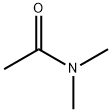 |
| CAS Number | 127-19-5 |
| Molecular Formula | C₄H₉NO |
| Molecular Weight | 87.12 g/mol |
| InChIKey | FXHOOIRPVKKKFG-UHFFFAOYSA-N |
| SMILES | Available on request where applicable |
| Appearance | Colourless liquid with a faint amine-like odour |
| Purity / Grade | By agreed specification and batch COA |
| Storage | Keep tightly closed in a cool, dry, well-ventilated place |
N,N-Dimethylacetamide (CAS 127-19-5), abbreviated DMAc, is a polar aprotic solvent with the formula C₄H₉NO (MW 87.12). It is a colourless liquid miscible with water and most organic solvents, with a high boiling point (165 °C) and strong solvency for polar polymers and inorganic salts. DMAc is used in polymer fiber spinning (polyimide, aramid), pharmaceutical synthesis, and as a reaction medium for high-temperature processes.
TCS Industries Limited, a Hong Kong-based trading and sourcing company, supplies DMAc in technical and high-purity grades for global procurement programs.
> Applications
Polymer dissolution and fiber spinning
DMAc is the primary solvent for polyimide (Kapton), aramid (Kevlar, Nomex), and polyacrylonitrile (PAN) fiber spinning processes. Its ability to dissolve high-molecular-weight aromatic polyamides at room temperature makes it essential for high-performance fiber manufacturing. DMAc is recovered and recycled in closed-loop systems in fiber plants. Afshari et al. (J Appl Polym Sci, 2008, 108:543–551) characterized the DMAc/polymer solution properties critical to aramid fiber spinning.
Pharmaceutical and chemical synthesis solvent
DMAc is used as a reaction solvent in pharmaceutical API synthesis, particularly for reactions requiring high-temperature, polar aprotic conditions. It is an ICH Class 2 solvent (PDE 10.9 mg/day) — residual levels in APIs must be controlled per ICH Q3C guidelines. Its solvency for inorganic salts (LiCl, CaCl₂) makes it useful for Grignard and metal-catalyzed reactions.
> Sourcing & Supply
TCS Industries Limited supports development, qualification and commercial purchasing discussions for N,N-Dimethylacetamide with buyers in Germany, France, Italy, Spain, the United Kingdom, the United States, Canada and Australia.
- Evaluation and commercial quantities: 25 L cans for qualification; 200 L drums and IBC for production. Technical and high-purity grades available.
- Pallet quantities and production campaigns: repeat supply is coordinated against packaging, lead time, annual demand and destination-market import requirements.
> Quality & Documentation
Key specification parameters include assay (≥99.5% for technical, ≥99.8% for high-purity), water content (≤0.05% for high-purity), colour (≤10 APHA), acidity (as acetic acid), dimethylamine content, UV absorbance, refractive index, and specific gravity. COA and MSDS are standard.
> Packaging
DMAc is a stable liquid at room temperature (m.p. -20 °C, b.p. 165 °C, flash point 63 °C). Standard packaging includes 200 L steel drums or 1000 L IBC. Not classified as dangerous goods for standard transport. Store in a well-ventilated area. Labels and documents are checked before dispatch.
> Pricing & MOQ
Pricing is quoted by specification, packaging and destination. Common commercial discussions use 25 kg bag/drum formats, pallet quantities and production-campaign planning; smaller samples may be reviewed for qualified formulation teams.
> Regulatory & Compounding Context
DMAc is classified as ICH Class 2 solvent (PDE 10.9 mg/day) for pharmaceutical manufacturing. REACH-registered. Classified as Toxic to Reproduction Category 1B (H360D) in the EU — subject to SVHC assessment and workplace exposure restrictions. OEL: 10 ppm (ACGIH TLV). Not classified as flammable (flash point 63 °C). Transport: non-hazardous for standard shipping. Buyers must confirm local reproductive toxicity regulations and workplace controls.
> Alias Index
- IUPAC: N,N-Dimethylacetamide
- CAS Number: 127-19-5
- Formula: C₄H₉NO (MW 87.12)
- Common names: DMAc, DMAC, Dimethylacetamide
- Physical properties: b.p. 165 °C, flash point 63 °C, density 0.937 g/mL
- ICH classification: Class 2 (PDE 10.9 mg/day)
- EU classification: Repr. 1B (H360D)
- InChIKey: FXHOOIRPVKKKFG-UHFFFAOYSA-N
- Commercial request terms: DMAc solvent, N,N-dimethylacetamide, polymer spinning solvent, DMAC high purity, TCS Industries Limited
> FAQ
Is DMAc classified as reproductive toxicant?
Yes. DMAc is classified as Toxic to Reproduction Category 1B (H360D) in the EU. Workplace exposure must be minimized with engineering controls, personal protective equipment, and biological monitoring. OEL is 10 ppm (ACGIH TLV). Confirm local regulatory requirements before procurement.
What documents are available for N,N-Dimethylacetamide orders?
COA and MSDS are standard for commercial discussions. COO, packing list, invoice and other import-support documents can be arranged according to order scope.
Do you supply N,N-Dimethylacetamide to Germany, France and Spain?
Yes. We support B2B buyers in Germany, France, Italy, Spain, the United Kingdom, the Netherlands, Poland and Switzerland, subject to route and document review.
Do you supply the United States, Canada and Australia?
Yes. We review the United States, Canada, Australia and New Zealand for project supply, import documents, packaging and logistics planning before quotation.
What is the ICH solvent class of DMAc?
DMAc is ICH Class 2 with a PDE of 10.9 mg/day. Residual DMAc levels in pharmaceutical APIs must be controlled and reported per ICH Q3C. ICH Class 2 solvents should be limited to protect patient safety.
What is the difference between DMAc and DMF?
DMAc (CAS 127-19-5, b.p. 165 °C) and DMF (CAS 68-12-2, b.p. 153 °C) are both polar aprotic amide solvents. DMAc has slightly higher solvency for aromatic polymers and higher thermal stability. Both are ICH Class 2 and Repr. 1B. DMAc is preferred for aramid and polyimide dissolution.
Can you arrange samples before commercial purchasing?
Samples or evaluation quantities may be reviewed for qualified buyers after target specification, application and destination-market requirements are clarified.
How is N,N-Dimethylacetamide packaged for export?
Packaging is confirmed by quantity and material properties. Typical options include foil bags, HDPE containers, fibre drums, 25 kg bags or palletized export packaging.
Can buyer-defined specifications be reviewed?
Yes. Send the specification, methods, impurity limits and required documents. TCS can review feasibility before confirming quotation and lead time.
What payment terms are normally used?
Standard payment is 100% T/T before dispatch unless a different arrangement has been approved for an established commercial account.
What lead time should buyers expect?
Lead time depends on stock, batch size, document scope and destination. Available stock can move faster; made-to-order or pallet programs require longer planning.
Is DMAc recyclable in industrial processes?
Yes. DMAc is recovered and recycled in closed-loop distillation systems in fiber spinning plants. Recovery rates exceed 95% in well-designed systems. Recycled DMAc must be re-tested for purity, water content, and dimethylamine before reuse. This is standard practice in aramid fiber manufacturing.
Last reviewed: June 2026
Evaluation and research orders (≤10 kg) are shipped with COA, MSDS, and certificate of origin. Bulk commercial orders (>10 kg) qualify for volume pricing with a full technical documentation package available on request.
> Request a Quote
If your team already has a target application, estimated quantity, destination market, or documentation requirements, send those details so the commercial response can be prepared more efficiently.