
TCS Industries Limited (China-sourced API supplier) supplies Erythritol — Pharmaceutical Excipient CAS 149-32-6 for pharmaceutical B2B procurement — COA, MSDS, and technical documentation available on request.
> Overview
| Product Name | Erythritol |
|---|---|
| Structural Formula | 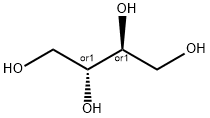 |
| CAS Number | 149-32-6 |
| Molecular Formula | C₄H₁₀O₄ |
| Molecular Weight | 122.12 g/mol |
| InChIKey | UNXHWFMMPAWVPI-ZXZARUISSA-N |
| SMILES | Available on request where applicable |
| Appearance | White crystalline powder |
| Purity / Grade | By agreed specification and batch COA |
| Storage | Keep tightly closed in a cool, dry, well-ventilated place |
Erythritol (CAS 149-32-6) is a four-carbon sugar alcohol (polyol) with the formula C₄H₁₀O₄ (MW 122.12). It occurs naturally in fruits and fermented foods and is produced commercially by fermentation of glucose using Moniliella pollinis or Trichosporonoides megachiliensis. Erythritol provides 60–70% of sucrose sweetness with essentially zero calories (0.2 kcal/g) and no glycemic impact, making it the preferred bulk sweetener for zero-calorie and diabetic-friendly food products.
TCS Industries Limited, a Hong Kong-based trading and sourcing company, supplies Erythritol in food and pharmaceutical grades for global procurement programs.
> Applications
Zero-calorie bulk sweetener for food products
Erythritol is used as a bulk sweetener in sugar-free chocolate, baked goods, beverages, tabletop sweeteners, and confectionery. It provides body and mouthfeel without the caloric content of sucrose. Unlike other polyols (sorbitol, maltitol, xylitol), erythritol is absorbed in the small intestine and excreted unchanged in urine, causing minimal gastrointestinal side effects at typical consumption levels. Munro et al. (Food Chem Toxicol, 1998, 36:1139–1174) reviewed the toxicological assessment supporting erythritol approval as a food additive.
Pharmaceutical excipient and carrier
Erythritol is used as a diluent, carrier, and sweetening agent in pharmaceutical formulations including lozenges, chewable tablets, and dry powder inhalers. Its non-hygroscopic nature and good compressibility make it suitable for direct compression tableting. It does not promote dental caries and has a cooling effect in the mouth.
> Sourcing & Supply
TCS Industries Limited supports development, qualification and commercial purchasing discussions for Erythritol with buyers in Germany, France, Italy, Spain, the United Kingdom, the United States, Canada and Australia.
- Evaluation and commercial quantities: 25 kg bags for qualification; pallet and bulk for production. Powder and granular forms in food and pharmaceutical grades available.
- Pallet quantities and production campaigns: repeat supply is coordinated against packaging, lead time, annual demand and destination-market import requirements.
> Quality & Documentation
Key specification parameters include assay (≥99.0% by HPLC), ribitol and glycerol content, reducing sugars, residue on ignition, loss on drying (≤0.2%), heavy metals (Pb ≤0.5 ppm), arsenic, pH, conductivity, and microbial limits. Identity confirmed by HPLC retention time, melting point (119–123 °C), and specific rotation. White crystalline powder or granular. COA and MSDS are standard.
> Packaging
Erythritol is non-hygroscopic and stable under normal conditions. Standard packaging includes 25 kg paper bags with PE liner, palletized and shrink-wrapped. 1000 kg FIBC for bulk orders. Store at room temperature in dry conditions. Shelf life is typically 36 months. Labels and documents are checked before dispatch.
> Pricing & MOQ
Pricing is quoted by specification, packaging and destination. Common commercial discussions use 25 kg bag/drum formats, pallet quantities and production-campaign planning; smaller samples may be reviewed for qualified formulation teams.
> Regulatory & Compounding Context
Erythritol is approved as a food additive in the EU (E968, Regulation 1333/2008, quantum satis for most categories), US (GRAS, FDA no-objection letters), Japan, and globally. Monographed in FCC and JECFA. In the EU, polyol labeling requires the statement “excessive consumption may produce laxative effects” — though erythritol has the highest digestive tolerance among polyols. No ADI specified (JECFA: not limited). No special import permits.
> Alias Index
- IUPAC: (2R,3S)-Butane-1,2,3,4-tetrol
- CAS Number: 149-32-6
- Formula: C₄H₁₀O₄ (MW 122.12)
- EU food additive: E968
- Caloric value: 0.2 kcal/g (EU), 0 kcal/g (US FDA labeling)
- Sweetness: 60–70% of sucrose
- InChIKey: UNXHWFMMPAWVPI-ZXZARUISSA-N
- Commercial request terms: erythritol food grade, E968, zero-calorie sweetener, sugar alcohol bulk, TCS Industries Limited
> FAQ
Why does Erythritol cause less GI distress than other polyols?
Erythritol is a 4-carbon polyol absorbed (60–90%) in the small intestine and excreted unchanged in urine. Other polyols (sorbitol, maltitol, xylitol) are 6-carbon and reach the colon where fermentation causes gas and osmotic diarrhea. This makes erythritol the best-tolerated polyol at food-level consumption.
What documents are available for Erythritol orders?
COA and MSDS are standard for commercial discussions. COO, packing list, invoice and other import-support documents can be arranged according to order scope.
Do you supply Erythritol to Germany, France and Spain?
Yes. We support B2B buyers in Germany, France, Italy, Spain, the United Kingdom, the Netherlands, Poland and Switzerland, subject to route and document review.
Do you supply the United States, Canada and Australia?
Yes. We review the United States, Canada, Australia and New Zealand for project supply, import documents, packaging and logistics planning before quotation.
Is Erythritol produced by fermentation?
Yes. Commercial erythritol is produced by fermentation of glucose using osmophilic yeasts (Moniliella pollinis or Trichosporonoides megachiliensis). The fermentation product is purified by crystallization. This is not a chemical synthesis process.
Is Erythritol suitable for diabetic products?
Erythritol has a glycemic index of 0 and does not raise blood glucose or insulin levels. It is suitable for diabetic-friendly food products and is widely used in ketogenic and low-carb formulations. It is classified as a non-cariogenic sweetener.
Can you arrange samples before commercial purchasing?
Samples or evaluation quantities may be reviewed for qualified buyers after target specification, application and destination-market requirements are clarified.
How is Erythritol packaged for export?
Packaging is confirmed by quantity and material properties. Typical options include foil bags, HDPE containers, fibre drums, 25 kg bags or palletized export packaging.
Can buyer-defined specifications be reviewed?
Yes. Send the specification, methods, impurity limits and required documents. TCS can review feasibility before confirming quotation and lead time.
What payment terms are normally used?
Standard payment is 100% T/T before dispatch unless a different arrangement has been approved for an established commercial account.
What lead time should buyers expect?
Lead time depends on stock, batch size, document scope and destination. Available stock can move faster; made-to-order or pallet programs require longer planning.
What is the caloric value of Erythritol?
EU labeling assigns 0.2 kcal/g (based on EU polyol regulation). US FDA permits labeling at 0 kcal/g (based on metabolic fate — absorbed but not metabolized). This regulatory difference affects nutrition label calculations depending on target market.
Last reviewed: June 2026
Evaluation and research orders (≤10 kg) are shipped with COA, MSDS, and certificate of origin. Bulk commercial orders (>10 kg) qualify for volume pricing with a full technical documentation package available on request.
> Request a Quote
If your team already has a target application, estimated quantity, destination market, or documentation requirements, send those details so the commercial response can be prepared more efficiently.